July 13 2026
AI-Proof Careers Abroad: Degrees That Will Stay Relevant Beyond 2030
Artificial Intelligence (AI) is redefining the global job market faster than ever before. From automating routine tasks to improving productivity across industries, AI is changing how businesses operate. While this creates exciting opportunities, it also raises an important question for students planning to study abroad: Will my degree still be relevant after 2030? The reality is that AI is not replacing every profession. Instead, it is changing the nature of work and increasing demand for careers that require human judgment, creativity, empathy, leadership and practical expertise. Choosing the right degree today can help you build a rewarding international career for years to come. In this guide, we will explore some of the best AI-proof careers abroad, the degrees expected to remain valuable beyond 2030, and how to choose a course with strong long-term career prospects.
Why Choosing an AI-Proof Career Matters Today
AI is becoming part of almost every industry, automating routine tasks such as data entry, report generation and basic coding. However, careers that rely on critical thinking, creativity, emotional intelligence and hands-on expertise continue to require human skills. Instead of replacing professionals, AI is changing how people work. Graduates who can combine industry knowledge with AI skills will be better prepared for the future job market. For international students, choosing the right degree can also improve long-term employability and open doors to global career opportunities.
What Makes a Career AI-Proof?
Although AI can process information quickly, it still cannot fully replicate many human abilities. Some AI-proof jobs abroad are likely to remain relevant usually involve one or more of these characteristics:
- Critical thinking and problem-solving
- Emotional intelligence and empathy
- Creativity and innovation
- Leadership and communication
- Ethical judgment and decision-making
- Practical and hands-on technical expertise
- Working in unpredictable real-world situations
These are skills that continue to be highly valued across industries and are difficult to automate.
Top AI-Proof Degrees to Study Abroad Beyond 2030
1. Healthcare and Medicine
Healthcare remains one of the safest and most rewarding career choices. Doctors, nurses, physiotherapists, occupational therapists and public health professionals deliver essential care that relies on human expertise, empathy and clinical judgement. With ageing populations in many countries, demand for qualified healthcare professionals is expected to remain strong. While AI can support diagnosis, medical imaging and administrative tasks, it cannot replace the complex decision-making, personalised care and human expertise that healthcare professionals provide.
Popular study destinations
- Australia
- Canada
- Germany
- Ireland
Career opportunities
- Registered Nurse
- Medical Practitioner
- Physiotherapist
- Public Health Specialist
2. Artificial Intelligence and Data Science
It may seem surprising, but one of the best ways to stay ahead of AI is to build and improve it. Professionals in AI and Data Science develop intelligent systems, analyze complex datasets and ensure AI technologies are used responsibly. As more businesses adopt AI, demand for these specialists continues to grow. Various study in Canada and Germany options helps you find the right universities and scholarships options.
Popular study destinations
- USA
- Canada
- Germany
- Netherlands
Career opportunities
- AI Engineer
- Data Scientist
- Machine Learning Engineer
- AI Consultant
3. Cybersecurity
As organizations become increasingly digital, protecting sensitive information has become a top priority. As one of the best degrees for the future, Cybersecurity professionals identify threats, strengthen security systems and respond to cyberattacks. Since cybercriminals constantly evolve their methods, human expertise remains essential. If you need expert guidance in selecting the right university and programme, our study abroad services can help simplify the process.
Career opportunities
- Security Analyst
- Ethical Hacker
- Information Security Consultant
- Cybersecurity Engineer
4. Engineering
Engineering continues to evolve alongside technology. AI can support engineers, but it cannot replace the creativity, technical expertise and practical problem-solving needed to design infrastructure, renewable energy systems, robotics or biomedical devices.
High-demand engineering specializations include:
- Civil Engineering
- Electrical Engineering
- Mechanical Engineering
- Biomedical Engineering
- Robotics
- Renewable Energy Engineering
- Mechatronics
5. Psychology and Mental Health
Mental health awareness is increasing worldwide, creating strong demand for qualified professionals. Psychologists and counselors help individuals manage emotional and behavioral challenges through empathy, communication and trust. These qualities remain uniquely human.
Career opportunities
- Clinical Psychologist
- Counselor
- Behavioral Therapist
- Mental Health Consultant
6. Environmental Science and Sustainability
Governments and businesses are investing heavily in sustainable development and renewable energy. As one of the best study abroad courses with high employability, professionals in environmental science help organizations reduce environmental impact, improve sustainability practices and develop green technologies.
Growing career areas include:
- Environmental Management
- Renewable Energy
- Climate Science
- Sustainability Consulting
- ESG Management Student Visa Assistance High-demand jobs abroad
7. Education and Learning Technologies
Technology has transformed classrooms, but great teaching involves much more than sharing information. Educators inspire students, adapt lessons to different learning needs and foster critical thinking. This makes education one of the most resilient professions. While AI can personalise learning and automate routine tasks, it cannot replace the mentorship, emotional support and meaningful human relationships that teachers provide. Students planning to study in Ireland or study in Australia can find internationally recognised education programmes.
Popular fields include:
- Educational Technology
- Curriculum Design
- Special Education
- Educational Leadership
8. Law and Public Policy
As technology advances, legal systems must adapt to new challenges involving AI, privacy, cybersecurity, intellectual property and digital governance. Professionals with expertise in technology law and policy are expected to remain in demand.
Career options include:
- Corporate Lawyer
- Compliance Officer
- Policy Analyst
- Digital Privacy Consultant
Emerging AI Careers to Watch Beyond 2030
Let’s check some future-proof careers after 2030;
| Field | Emerging Career Roles | What They Do |
| Artificial Intelligence | AI Engineer, Machine Learning Engineer, AI Governance Specialist | Develop AI systems, train machine learning models and ensure AI is used responsibly. |
| Data & Analytics | Data Scientist, Big Data Specialist | Analyze large datasets to generate insights and support business decisions. |
| Cybersecurity | Cybersecurity Specialist, Security Management Specialist | Protect systems, detect cyber threats and strengthen digital security. |
| Healthcare | Digital Health Specialist, Bioinformatics Scientist | Combine healthcare with digital technologies and analyze biological data to improve patient care and medical research. |
| Sustainability | Renewable Energy Engineer, Climate Risk Analyst | Develop clean energy solutions and assess climate-related risks for organizations. |
| Robotics & Automation | Robotics Engineer, Autonomous Systems Engineer | Design, build and improve robots and autonomous systems for industries such as manufacturing and logistics. |
| Law & Governance | AI Ethics Specialist, AI Policy Advisor, Technology Lawyer | Develop AI regulations, ensure legal compliance, address ethical issues and advise organizations on the responsible use of AI and emerging technologies. |
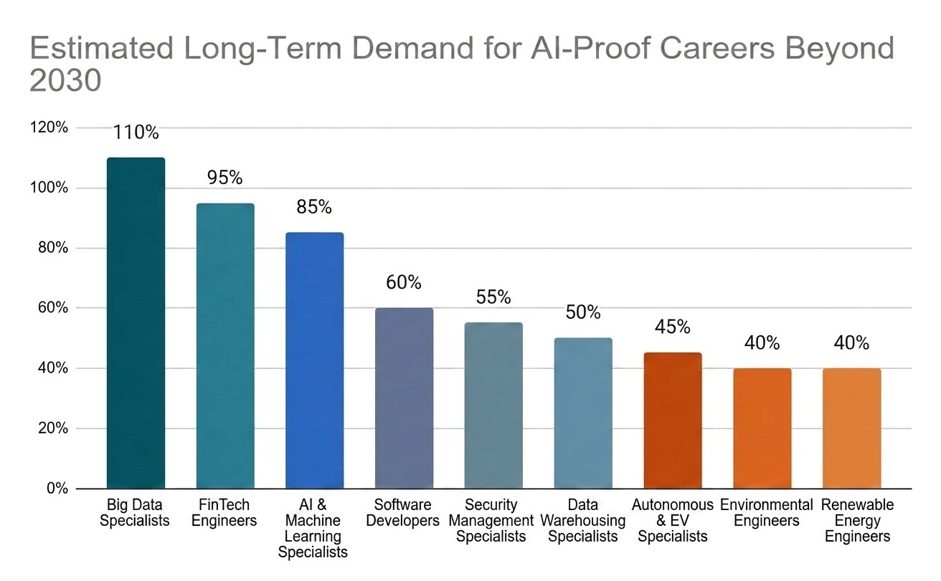
Estimated Long-Term Demand for AI-Proof Careers Beyond 2030
Source: World Economic Forum, Future of Jobs Report 2025
Source: World health organization
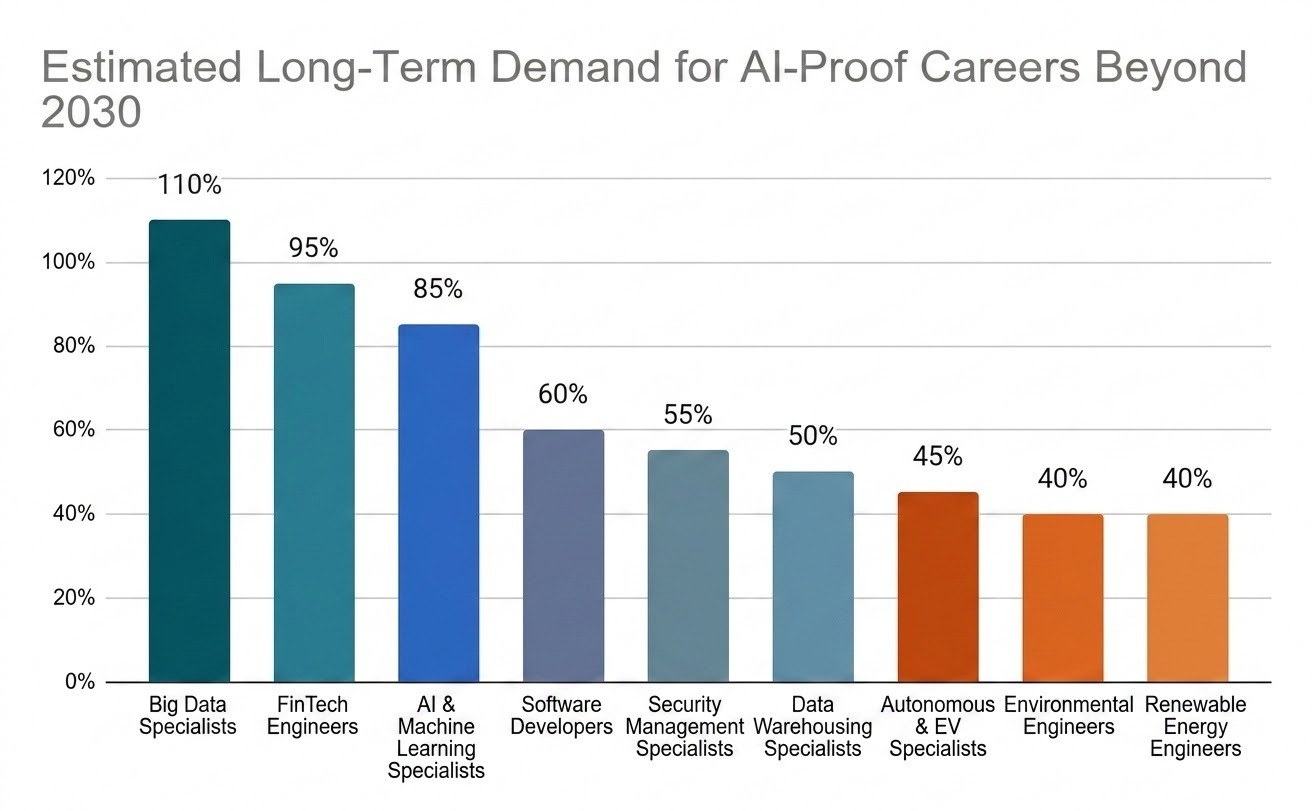
Global Health Workforce (70 Million) & Projected Shortage by 2030 (11 Million): The global healthcare sector currently employs more than 70 million professionals, yet the World Health Organization (WHO) estimates a shortage of around 11 million health workers by 2030, highlighting the sustained global demand for healthcare careers.
Best Countries for Future-Proof Careers
Different countries specialize in different industries. Choosing the right destination can improve your career prospects.
| Country | High-Demand Fields |
| Australia | Healthcare, Engineering, Education |
| Canada | Healthcare, Cybersecurity, Technology |
| Germany | Engineering, AI, Manufacturing |
| Ireland | Data Science, Pharmaceuticals |
| Netherlands | AI, Sustainability, Engineering |
| New Zealand | Healthcare, Construction, Engineering |
Many of these countries also offer post-study work opportunities and skilled migration pathways for eligible graduates.
Skills Employers Will Value Beyond 2030
A degree alone is no longer enough. Employers increasingly look for graduates with transferable skills that remain valuable even as technology evolves.
Some of the most important skills include:
- Communication
- Leadership
- Critical thinking
- Creativity
- Problem-solving
- Digital literacy
- AI literacy
- Cross-cultural communication
- Adaptability
- Project management
- Teamwork
Developing these skills alongside your academic qualifications can significantly improve your employability.
How to Choose the Right Degree
Before selecting a course, ask yourself:
- Does this career genuinely interest me?
- Is there long-term demand for this profession?
- Will the course include internships or practical training?
- Are the qualifications internationally recognized?
- Does the country offer post-study work opportunities?
- Is the profession difficult to automate?
- Does it match my long-term career goals?
Choosing a degree based on both your interests and future job prospects often leads to the best outcome
Common Mistakes Students Make
Many students focus only on today's trends instead of long-term opportunities.
Avoid these common mistakes:
- Choosing a course because it is currently popular
- Ignoring automation risks
- Following friends instead of personal interests
- Looking only at starting salaries
- Not researching post-study work options
- Overlooking professional licensing requirements
- Ignoring labour market demand
A well-informed decision today can create better opportunities in the future.
Tips to Choose the Right AI-Proof Career
To make a well-informed decision, keep these tips in mind:
- Will AI support this job or perform most of its daily tasks? Choose careers where AI is more likely to assist professionals than replace them.
- Does the course develop practical skills? Degrees with internships, lab work, clinical placements or field training are often more resilient to automation.
- Will you solve real-world problems? Careers that involve critical thinking, decision-making, or working with people are harder to automate.
- Is the profession in demand globally? Check skill shortage lists and labour market reports for your preferred study destination.
- Can you combine the degree with AI skills? Learning how to use AI tools alongside your subject can improve your career prospects.
- Does the field offer long-term growth? Look beyond today's trends and choose industries expected to expand over the next decade.
How Berakah Elite Helps You Choose the Right Future-Proof Degree
Planning to study abroad involves many important decisions and choosing the right course is one of the biggest. It involves understanding global skill shortages, industry demand, post-study work opportunities and how emerging technologies like AI are reshaping different professions. At Berakah Elite, we help you evaluate these factors to identify the best courses to study abroad in 2026 that align with your interests and long-term career goals. Once you have selected your preferred destination, our Student Visa Assistance team can guide you through every step of the visa application process. From choosing the right university and country to assisting with applications, scholarship opportunities and post-study career planning, our team provides comprehensive guidance to help you build a successful international career in a rapidly evolving job market.
Conclusion
AI is reshaping the future of work, but it is also creating new opportunities for professionals with the right skills. Careers that rely on creativity, empathy, leadership, practical expertise and complex decision-making are expected to remain valuable well beyond 2030. When planning your study abroad journey, don't focus only on what's popular today. Choose a degree that matches your interests, develops future-ready skills and aligns with global industry demand. With the right education and guidance, you can build a successful AI-Proof careers abroad that grows alongside technology instead of competing with it. Unsure whether your dream course will still be in demand after graduation? Speak with our Berakah Elite counsellors for a personalised career roadmap based on your interests, budget, and global job opportunities.
Frequently Asked Questions
- What are AI-proof careers abroad?
AI-proof careers are professions that rely on human skills such as critical thinking, creativity, empathy, leadership and practical expertise, making them less likely to be fully automated.
- Which degrees are expected to remain relevant beyond 2030?
As the future careers for international students, Healthcare, Artificial Intelligence, Data Science, Cybersecurity, Engineering, Psychology, Environmental Science, Education and Law are expected to offer strong long-term career opportunities.
- Can I combine AI skills with a non-technical degree?
Yes. Students in healthcare, business, law, education, marketing and many other fields can improve their career prospects by learning how to use AI tools alongside their professional expertise.
- Which country is best for future-proof careers?
Australia, Canada, Germany, Ireland, the Netherlands and New Zealand all offer excellent opportunities depending on your chosen field, along with attractive post-study work options.
- Can AI replace doctors and engineers?
AI can assist professionals by improving efficiency and supporting decision-making, but it cannot replace the human judgment, practical expertise and responsibility required in these professions.
- How do I choose an AI-proof study abroad course?
Look for careers that match your interests, offer practical training, align with global labour market demand, provide post-study work opportunities and develop skills that are difficult to automate beyond 2030.

Recent updates
AI Is Changing University Admissions: How Students Can Build an Application That Still Stands Out
September 23 2026
Scholarships for Indian Students in 2026: Funding Opportunities You Should Know About
September 23 2026
Study Abroad Without the Big Four: Which Emerging Destinations Are Gaining Indian Students in 2026?
September 17 2026
Green Jobs Abroad in 2026: Which Degrees Can Lead to Careers in Renewable Energy, ESG & Climate Tech?
September 16 2026
Student Visa Rules in 2026: Latest Updates Every Indian Student Should Know
August 10 2026
Best Cities in New Zealand for Indian Students in 2026: Jobs, Rent, Student Life & Part-Time Opportunities
August 6 2026
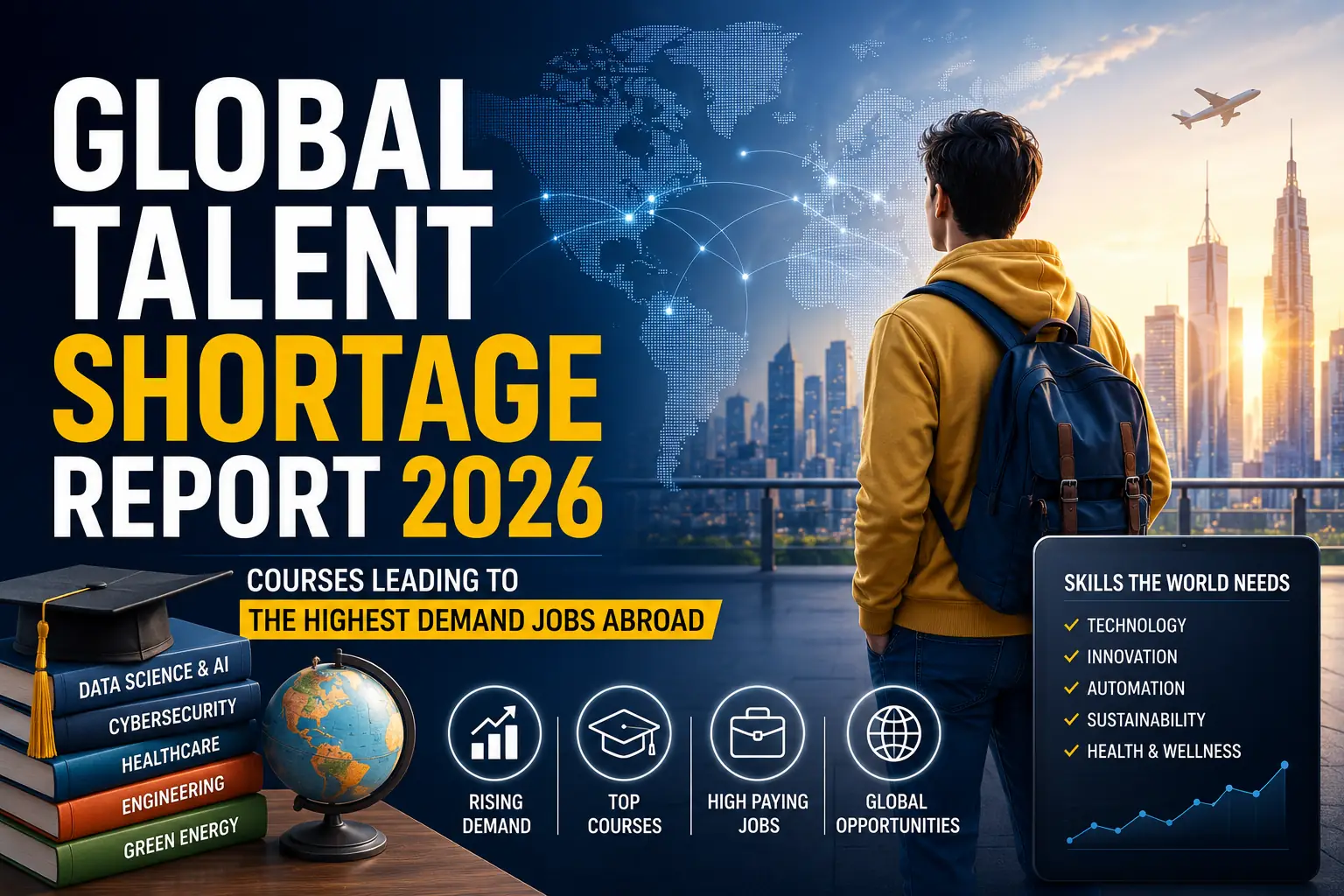
Global Talent Shortage Report 2026: Courses Leading to the Highest-Demand Jobs Abroad
July 11 2026
Study Abroad vs Skill-Based Migration: Which Route Offers Better Career Growth in 2026?
July 8 2026
Countries That Allow International Students to Bring Dependents in 2026
July 4 2026