September 23 2026
Scholarships for Indian Students in 2026: Funding Opportunities You Should Know About
Planning to study abroad but worried about the cost? What if the right scholarship could change your entire funding plan?
Scholarships for Indian students 2026 can significantly ease the cost of higher education abroad. Securing admission is one milestone. Funding tuition, accommodation, travel and daily expenses is another.
But are scholarships only for academic toppers? Absolutely not.
Funding can come from universities, governments, private organisations, industry bodies and research institutions. Full scholarships are one route. Smaller grants, fee waivers and multiple funding sources can also reduce the overall cost.
The real challenge is knowing where to look, understanding what you qualify for and applying at the right time. Let’s explore the scholarship options available and find the ones that best fit your study plans.
Why Indian Students Are Missing Scholarships in 2026
Many students search for scholarships only after finalising their university. This can limit their options, particularly when funding deadlines are earlier than admission deadlines.
Common reasons include:
- Searching only for fully funded awards: Partial fee waivers can also substantially reduce study costs.
- Focusing on famous scholarships: Highly competitive awards such as Chevening, Fulbright and Erasmus Mundus receive significant attention, while smaller university and departmental awards are often overlooked.
- Missing separate deadlines: Scholarship deadlines may differ from university application deadlines.
- Assuming grades are everything: Some awards consider leadership, professional experience, research potential, financial need or creative portfolios.
How Can Indian Students Plan Study-Abroad Funding in 2026?
Funding your studies abroad does not always have to depend on one large scholarship. Depending on the scholarship terms and your financial situation, you can explore multiple sources of funding including:
- University scholarships: Merit awards, tuition fee waivers and departmental funding
- Government scholarships: Funding offered through national scholarship programmes
- External grants: Support from organisations, foundations and industry bodies
- Personal funding: Savings or education loans
Scholarship opportunities can vary between intakes, including eligibility criteria, funding amounts, deadlines and participating universities. Indian students should therefore check the latest information through official sources before applying.
Useful official sources include:
- DAAD Scholarship Database for scholarships and funding opportunities in Germany.
- GREAT Scholarships, Study UK for UK scholarships available to Indian students.
- Erasmus Mundus Joint Masters for European joint master's programmes and scholarships.
- National Overseas Scholarship for the Indian government's overseas scholarship scheme.
Always verify the latest eligibility, funding details and application deadlines on the relevant official website before applying.
7 Funding Opportunities Indian Students Should Know About in 2026
1. DAAD Scholarships, Germany
https://www.daad.de/en/studying-in-germany/scholarships/daad-scholarships/
DAAD provides funding opportunities for international students and researchers across a range of postgraduate and research programs.
Its scholarship database allows students to explore opportunities based on factors such as subject area and study level.
Why students miss it: They often search for one general “DAAD scholarship” instead of exploring the different programs available.
2. GREAT Scholarships, UK
https://study-uk.britishcouncil.org/scholarships-funding/great-scholarships
GREAT Scholarships are jointly supported by the UK Government's GREAT Britain campaign and participating UK universities. Eligible students can receive a minimum £10,000 contribution towards tuition fees for selected one-year postgraduate programs.
Why students miss it: Many focus heavily on major awards such as Chevening and overlook university-specific opportunities.
3. Erasmus Mundus Joint Masters
https://erasmus-plus.ec.europa.eu/opportunities/individuals/students/erasmus-mundus-joint-masters
Erasmus Mundus Joint Masters are international master's programs delivered by partnerships of higher education institutions across countries.
Selected programs offer scholarships that can provide substantial financial support towards tuition and living costs.
Why students miss it: Applicants often search for scholarships by country rather than looking at the individual joint master's programs.
4. National Overseas Scholarship, India
The National Overseas Scholarship is an Indian government initiative supporting eligible students from specified communities pursuing master's or PhD-level study abroad.
Why students miss it: Students researching international scholarships often overlook funding opportunities offered by the Indian government.
5. University-Specific Scholarships
Universities themselves can offer some of the most accessible funding opportunities. These may include:
- Merit-based scholarships
- Tuition fee waivers
- Early application awards
- Faculty or departmental grants
- International student awards
Some awards may be considered automatically with the admission application, while others require a separate application.
Why students miss it: They often stop their search after checking major external scholarships.
6. Subject-Specific and Industry-Funded Scholarships
Funding can also come from companies, professional organisations, foundations and industry bodies.
Opportunities may target fields such as:
- STEM
- Artificial intelligence
- Media
- Design
- Research
- Technology
Why students miss it: Corporate and subject-specific funding receives less attention than well-known government scholarships.
7. Country-Specific Scholarships
Several countries provide scholarships or financial support specifically for international students. Exploring destinations beyond the most popular study markets can reveal additional opportunities.
For example, government scholarships for Indian students may be available through bilateral education initiatives or national scholarship programs.
Why students miss it: Students often limit their research to the countries they already have in mind.
Student Profile vs Recommended Funding Route
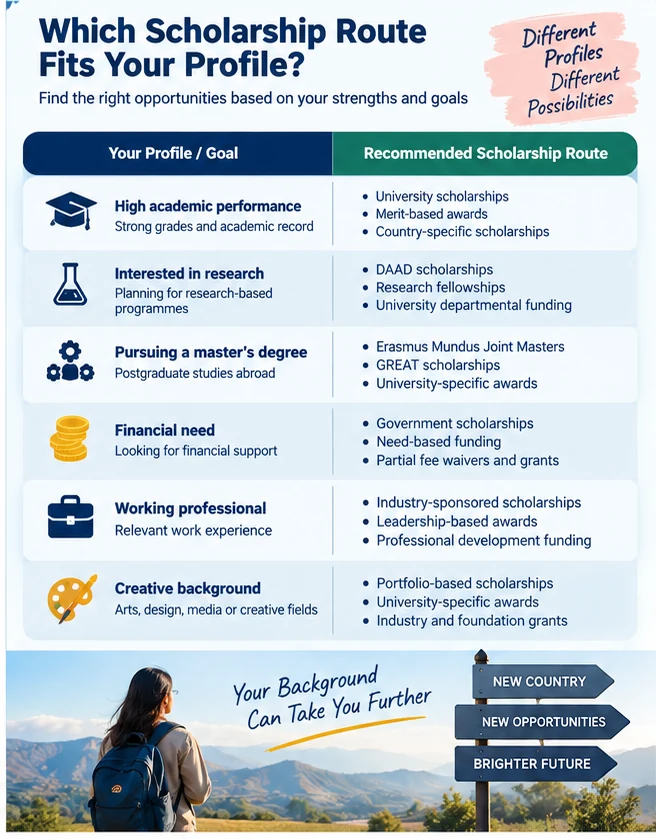
Your profile can help determine where to focus your scholarship search.
- STEM students: University, departmental and industry grants
- Research applicants: DAAD and research fellowships
- Master's applicants: Erasmus Mundus, GREAT and university awards
- Students with financial need: Need-based and government funding
- Working professionals: Leadership and professional awards
- Creative students: Portfolio and industry-funded opportunities
Fully Funded vs Partially Funded Scholarships: Which Should You Choose?
Fully Funded Scholarships
These may cover several major expenses, depending on the award:
- Tuition fees
- Living allowance
- Travel
- Health insurance
Partially Funded Scholarships
These may provide:
- A percentage of tuition fees
- A fixed tuition contribution
- Accommodation support
- Living-cost assistance
Do not overlook partial funding. A substantial tuition reduction combined with affordable accommodation and other financial support can significantly lower your overall study cost.
How to Find Scholarships Before the Deadline
A systematic search can help you to avoid missed opportunities.
- Shortlist your course and destination.
- Check the official university scholarship portal.
- Explore government scholarship databases.
- Search for subject and industry-specific funding.
- Check eligibility and award conditions carefully.
- Create a scholarship deadline tracker.
- Prepare your SOP, LORs, CV, transcripts and language test results early.
Start early. Some scholarship deadlines can fall months before your planned intake.
The Scholarship Mistake Indian Students Should Stop Making in 2026
One common mistake is sending the same application to every scholarship.
A stronger approach is to identify opportunities that genuinely match your academic background, experience, financial circumstances, course and destination.
Prepare your SOP and supporting documents to each scholarship's selection criteria.
Can a Study Abroad Consultant Help You Find Scholarships?
Yes. The right guidance can make your scholarship search more focused and efficient. A consultant can help with:
- Profile assessment
- University and course selection
- Scholarship identification
- Application timelines
- SOP positioning
- Documentation
- Visa guidance
Berakah Elite helps Indian students to explore study-abroad options including university selection, scholarships and visa guidance, so students can evaluate funding opportunities alongside their course and destination choices.
Scholarship availability and eligibility vary, so students should always review the official requirements before applying.
Conclusion
Studying abroad becomes more manageable when funding is planned alongside your course and university choice.
Follow a simple path:
Course → Country → University → Scholarship → Funding Plan
The right combination of scholarships, grants, fee waivers and personal funding can create valuable study abroad funding opportunities and support affordable study abroad for Indian students. Explore scholarships for Indian students 2026 based on your profile, goals and destination and start planning early.
Need help finding the right funding options? Berakah Elite can guide you through university selection, scholarship opportunities and your overall study abroad plan.
Frequently Asked Questions
1. What are the best scholarships for Indian students to study abroad in 2026?
Options include DAAD scholarships, GREAT Scholarships, Erasmus Mundus Joint Masters, the National Overseas Scholarship and university-specific awards. Eligibility and funding vary by programme.
2. When should Indian students start applying for scholarships?
Start researching scholarships as early as possible, ideally before finalizing your university and course. Scholarship deadlines can differ from university admission deadlines and some opportunities may close months before the intended intake. Check the official scholarship website for the current application timeline and prepare documents such as your SOP, LORs, CV and transcripts in advance.
3. How can Indian students get fully funded scholarships to study abroad?
Research eligible programs early, understand the selection criteria, prepare strong application documents and apply to scholarships that match your profile. Fully funded scholarships for Indian students are competitive, so students should also explore partial funding.
4.Can average students get scholarships to study abroad?
Yes. Some scholarships to study abroad for Indian students consider factors beyond academic scores including financial need, leadership, professional experience, research potential or creative portfolios.
5.What is the difference between fully funded and partially funded scholarships?
Fully funded awards can cover major expenses such as tuition, living costs, travel and insurance, depending on the program. Partial scholarships cover only specific costs, such as part of the tuition fee or accommodation.
6.When should Indian students start applying for scholarships?
Ideally, begin 8 to 12 months before your intended intake. Some scholarship deadlines can close well before university admission deadlines, so early preparation gives you more opportunities to apply.

Recent updates

AI Is Changing University Admissions: How Students Can Build an Application That Still Stands Out
September 23 2026
Study Abroad Without the Big Four: Which Emerging Destinations Are Gaining Indian Students in 2026?
September 17 2026

Green Jobs Abroad in 2026: Which Degrees Can Lead to Careers in Renewable Energy, ESG & Climate Tech?
September 16 2026
Student Visa Rules in 2026: Latest Updates Every Indian Student Should Know
August 10 2026

Best Cities in New Zealand for Indian Students in 2026: Jobs, Rent, Student Life & Part-Time Opportunities
August 6 2026

AI-Proof Careers Abroad: Degrees That Will Stay Relevant Beyond 2030
July 13 2026

Global Talent Shortage Report 2026: Courses Leading to the Highest-Demand Jobs Abroad
July 11 2026

Study Abroad vs Skill-Based Migration: Which Route Offers Better Career Growth in 2026?
July 8 2026

Countries That Allow International Students to Bring Dependents in 2026
July 4 2026