September 23 2026
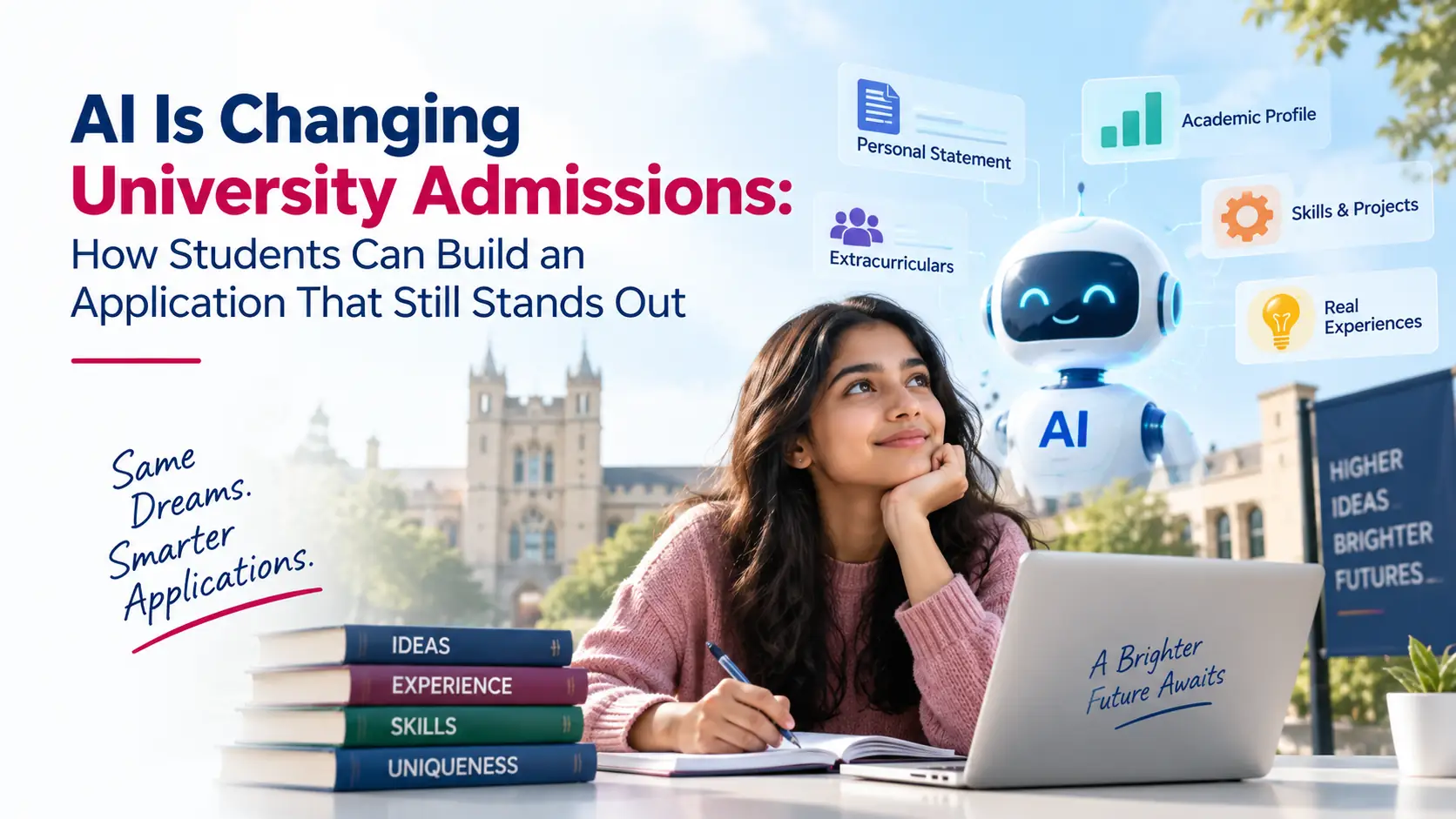
AI Is Changing University Admissions: How Students Can Build an Application That Still Stands Out
If AI can write an impressive SOP in seconds, what makes your university application different? AI is becoming part of the university application process, helping students research institutions, compare programmes, organise requirements and improve their writing. But when applicants rely too heavily on AI-generated content, applications can lose the personal details and individual perspective that make them distinctive. In 2026, a standout application requires more than polished language. It should reflect genuine experiences, clear academic motivation, thoughtful reasoning and defined career goals. AI in university admissions should enhance the process without replacing the student's personal voice or story.
How AI Is Changing University Admissions in 2026
1. How Applicants Are Using AI
As university applications using AI become more common, students use AI to research universities, compare entry requirements, understand courses and manage application deadlines more efficiently. AI can also support brainstorming, proofreading, writing clarity and interview practice. However, it should assist the student's thinking rather than replace it. AI policies vary by institution and application type. For example, the University of Cambridge permits limited AI use for ideas and research in undergraduate personal statements but warns against over-reliance and false claims.
https://www.undergraduate.study.cam.ac.uk/apply/ai-and-undergraduate-applications
2. How Universities Are Adapting
As the use of AI in college admissions grows, universities may place greater emphasis on the consistency and credibility of an applicant's overall profile. Academic records, recommendations, portfolios, projects and interviews can provide evidence beyond written applications. This makes it important for every part of the application to reflect the same academic and career story. AI can strengthen your application, but it should not become the applicant.
Admissions practices vary by institution. For example, Cambridge considers academic records, references, personal statements, submitted work and interviews, depending on the course.
https://www.undergraduate.study.cam.ac.uk/apply/after/admissions-policy
Can Universities Detect AI-Generated Applications?
There is no completely reliable way to identify AI-written content and AI detection tools can produce false positives. Students should follow each university's AI policy rather than focus on bypassing AI detectors. Oxford also notes that AI-generated application content can sound generic.
However, admissions teams may notice generic language, vague claims, unnatural phrasing or inconsistencies between an essay and the rest of an applicant's profile. The greater risk is submitting an application that sounds generic rather than genuinely reflecting you. Using AI for brainstorming, proofreading and feedback is different from using it to write your personal statement. Oxford recommends that personal statements demonstrate genuine motivation, relevant experience and suitability for the chosen course. Keep your experiences and reflections authentic.
5 Ways to Make Your University Application Stand Out in the AI Era
1. Focus on Real Experiences
Avoid broad claims like, “I have always been passionate about technology.”
Instead, explain what you did, what you learned and how it shaped your goals. Projects, challenges and meaningful experiences make your application more credible and memorable.
This approach aligns with current application guidance. UCAS encourages 2026 applicants to discuss their reasons for choosing a course, relevant study or work experience, achievements, skills and future ambitions.
2. Show Evidence of Your Interests
Do not simply state what you want to achieve. Demonstrate your interests through relevant internships, research, certifications, competitions, volunteering or independent projects.
Use this structure:
Claim → Experience → Learning → Future Goal
This shows clear evidence, reflection and direction.
3. Keep Your SOP Personal
Your Statement of Purpose (SOP) should highlight your academic journey and future plans, not sound like a generic template.
Answer these questions:
- Why this subject?
- Why this university and programme?
- What experiences prepared you?
- What are your career goals?
- How will this programme help you achieve them?
4. Use AI as a Coach, Not a Ghostwriter
AI can help with:
- Brainstorming ideas
- Correcting grammar
- Improving clarity
- Practicing interviews
- Organizing deadlines
Avoid using it to write your entire SOP, invent achievements or copy content directly. Always check the university’s AI policy.
5. Keep Your Application Consistent
Your academic background, experiences, programme choice and career goals should tell one clear story.
For example:
Academic background → Relevant project → Master’s programme → Career goal
A consistent application appears more credible, focused and well-researched.
What Makes an AI-Era University Application Different?
| Attribute | Generic Approach | Standout Application in the AI Era |
| Achievements | Broad claims | Specific experiences and outcomes |
| Language | Over-polished | Clear and authentic |
| Interest | “I am passionate about...” | Evidence of genuine interest |
| SOP | Templates or AI-generated contents | Student-led personal narrative |
| University choice | Generic reasons | Programme-specific alignment |
| Activities | Lists responsibilities | Explains learning and impact |
| Overall profile | Focuses mainly on scores | Presents a coherent academic story |
AI Application Mistakes Students Should Avoid
Avoid these common mistakes when using AI for your college application:
- Submitting an unedited AI-generated SOP.
- Using unnecessarily complex or unnatural vocabulary.
- Fabricating or exaggerating achievements.
- Reusing the same generic SOP for multiple universities.
- Ignoring university-specific AI policies.
- Allowing AI to replace personal reflection.
- Focusing more on defeating AI detectors than developing an authentic application.
University policies can differ significantly, so students should always check the current AI guidance for each institution and programme before using AI in an application. Oxford specifically recommends checking the policies of the institutions being targeted.
How Indian Students Can Build a Standout Study Abroad Application in 2026
For Indian students, a competitive study abroad application requires more than strong academic scores.
Build your profile around academic performance, practical experience, communication skills and clear career planning. Internships, projects, certifications and relevant extracurricular activities can provide useful evidence of your interests.
You should also prepare documentation carefully and develop a realistic understanding of your university choices, finances and post-study career direction.
This is where professional guidance can add value. Berakah Elite can help students connect university selection, profile evaluation, SOP strategy and application documentation into a structured study-abroad plan while keeping the student's own experiences and goals at the centre.
Conclusion
AI has made producing polished content easier than ever, changing how students approach AI university admissions. As polished content becomes easier to produce, genuine experiences and authentic narratives have become even more valuable in international university admissions.
The goal is not to compete with AI in SOP writing, but to communicate what AI cannot authentically provide: your experiences, decisions, learning and ambitions.
For students planning to study abroad in 2026, a strong application should clearly connect:
Who you are → What you have done → What you learned → Why you want to study → Where you want to go.
Planning to study abroad in 2026? Speak with Berakah Elite's admissions counsellors to build a university application aligned with your academic profile and career goals.
FAQs
1. Can I use ChatGPT for my university application?
Yes, where permitted by the university. You can use it for brainstorming, research support, organisation and proofreading. Avoid submitting AI-generated college essays as your own.
https://www.ucas.com/applying/applying-to-university/writing-your-personal-statement
2.Can universities detect AI-written essays?
AI detection tools are not completely reliable. However, universities can assess applications for generic language, lack of personal detail and inconsistencies across the applicant's profile.
3.How can I make my university application stand out?
Focus on specific experiences, measurable achievements, genuine reflection, programme-specific research and clear career goals. Your application should explain what you have done, what you learned and why your chosen programme is the logical next step.
4. Should I use AI to write my SOP?
It is better to keep the SOP student-driven. AI can help with structure, clarity and proofreading, but your experiences, motivations and reflections should remain your own.
5. What makes an international student application strong?
An authentic university application combines solid academic performance, relevant experience, real motivation, clear programme fit, realistic career goals and well-prepared documentation.

Recent updates
Scholarships for Indian Students in 2026: Funding Opportunities You Should Know About
September 23 2026
Study Abroad Without the Big Four: Which Emerging Destinations Are Gaining Indian Students in 2026?
September 17 2026

Green Jobs Abroad in 2026: Which Degrees Can Lead to Careers in Renewable Energy, ESG & Climate Tech?
September 16 2026
Student Visa Rules in 2026: Latest Updates Every Indian Student Should Know
August 10 2026

Best Cities in New Zealand for Indian Students in 2026: Jobs, Rent, Student Life & Part-Time Opportunities
August 6 2026

AI-Proof Careers Abroad: Degrees That Will Stay Relevant Beyond 2030
July 13 2026

Global Talent Shortage Report 2026: Courses Leading to the Highest-Demand Jobs Abroad
July 11 2026

Study Abroad vs Skill-Based Migration: Which Route Offers Better Career Growth in 2026?
July 8 2026
Countries That Allow International Students to Bring Dependents in 2026
July 4 2026