September 16 2026
Green Jobs Abroad in 2026: Which Degrees Can Lead to Careers in Renewable Energy, ESG & Climate Tech?
If you think a green career is only for environmental science graduates, the job market tells a different story. The growing green economy is creating opportunities across renewable energy, energy storage, electric mobility, climate technology, ESG, sustainable finance, environmental consulting, green construction, carbon management and energy analytics. The World Economic Forum identifies the green transition as a key force shaping the future of work, with renewable energy and environmental engineering among the fastest-growing fields. For students, this means green jobs abroad can build on many academic backgrounds. Engineering, technology, finance, business, architecture and other disciplines can all lead to careers in the expanding green economy.
https://www.weforum.org/publications/the-future-of-jobs-report-2025/in-full/2-jobs-outlook
Which Degrees Can Lead to Green Careers Abroad?
A green career can begin with many different academic backgrounds. Instead of choosing a degree solely because it includes the word “sustainability,” students should consider how their interests and skills can connect to growing green industries.
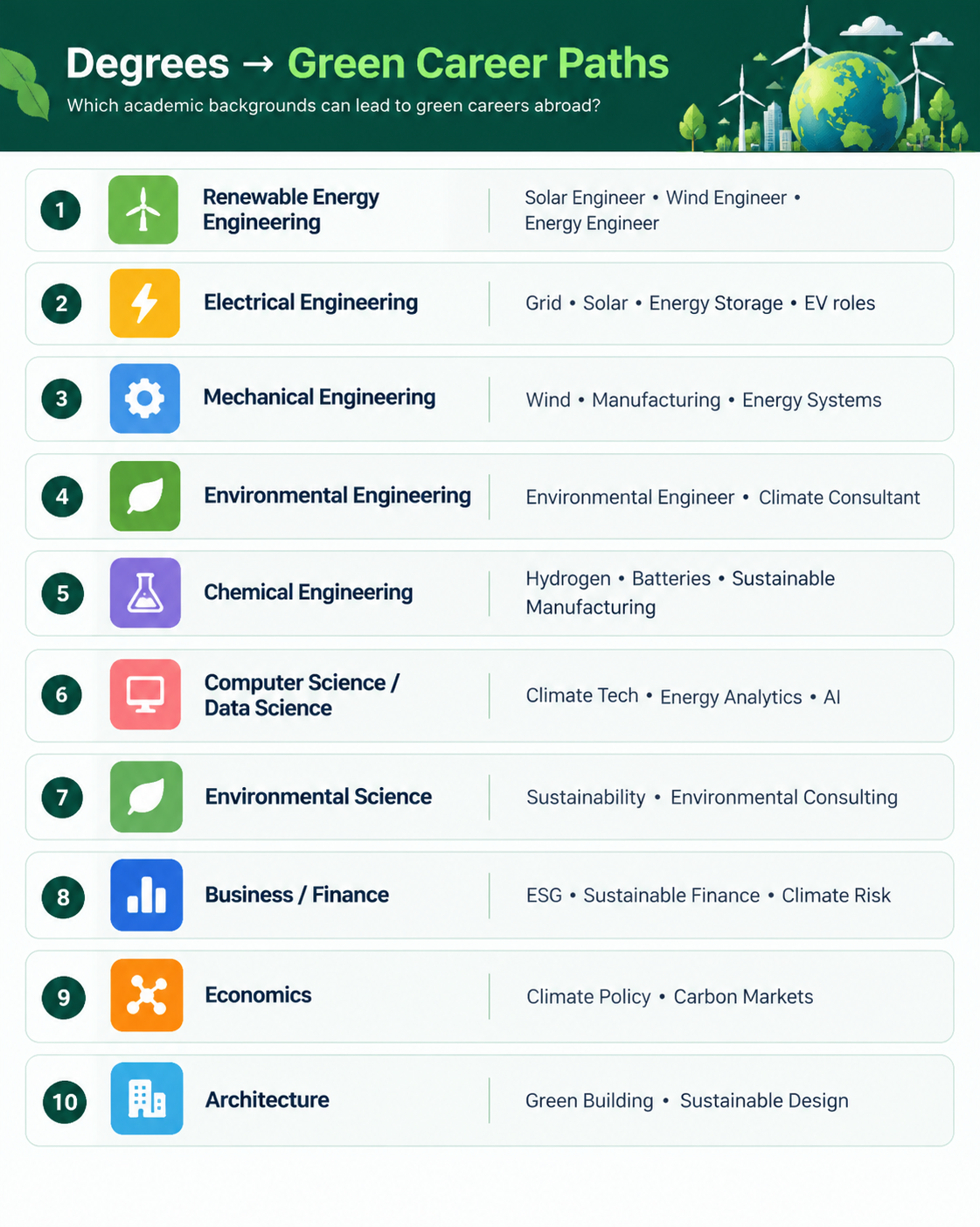
A degree alone does not guarantee a green job. Employers also look for practical skills, internships and real industry experience.
For instance, a computer science graduate can move into climate tech or energy analytics, while an electrical engineer can work in renewable energy, EVs or energy storage.
The key to building a green career in 2026 is to pair your degree with skills that match the career you want to pursue.
7 Green Career Paths Students Can Explore in 2026
Green jobs abroad go far beyond traditional environmental roles. Students from engineering, technology, finance, business and other backgrounds can explore different paths within the growing green economy. Here are seven green career paths to consider in 2026:
1. Renewable Energy Engineering
This field covers the design and development of clean energy systems, including solar and wind power.
Potential roles: Solar Engineer, Wind Engineer, Renewable Energy Engineer, Energy Systems Engineer
Key skills: Energy modelling, electrical systems, PV technology and grid integration.
2. Energy Storage & Battery Technology
As renewable energy expands, efficient energy storage is becoming increasingly important. This creates opportunities in battery development, storage systems and grid applications.
Potential roles: Battery Engineer, Energy Storage Specialist, Battery Systems Analyst, Grid-Storage Professional
3. ESG & Sustainability
ESG focuses on how organisations manage environmental, social and governance responsibilities. It is broader than renewable energy and offers opportunities beyond engineering.
Potential roles: ESG Analyst, Sustainability Consultant, Sustainability Reporting Specialist, Carbon Accounting Professional
4. Climate Tech
Climate technology combines technology with solutions to environmental and climate challenges. It can be particularly relevant for computer science and data science graduates.
Potential roles: Climate Data Analyst, AI/ML Specialist, Energy Software Developer, Climate-Tech Product Professional
5. Green Finance
Finance professionals can support the transition to a low-carbon economy through sustainable investment, climate-risk assessment and green financial products.
Areas: Sustainable Finance, Climate-Risk Analysis, Green Bonds and ESG Investment
6. Sustainable Construction & Infrastructure
The push for energy-efficient buildings and low-carbon infrastructure is creating demand for professionals who can design and improve sustainable spaces.
Potential roles: Sustainable Building Consultant, Environmental Engineer, Energy-Efficiency Specialist, Green Building Professional
7. Environmental & Climate Policy
Students interested in policy, regulation and environmental management can work on initiatives that shape how organisations and governments respond to climate challenges.
Potential roles: Environmental Consultant, Climate Policy Analyst, Environmental Compliance Specialist, Sustainability Policy Professional
Which Countries Offer Strong Green Career Opportunities?
For students planning to study abroad, the right country depends on the green sector they want to enter, available degree programmes, industry ecosystem, language, study costs and post-study work options. Each destination has different strengths within the growing green economy.
Germany
Germany is particularly relevant for students interested in renewable energy, energy systems, hydrogen, electrification and other green technologies. Its energy transition is driving continued investment in renewable power, electrification and technologies such as hydrogen and energy storage, creating opportunities across engineering and clean-energy industries.
https://www.make-it-in-germany.com/en/working-in-germany/green-jobs
Netherlands
The Netherlands is a strong option for students interested in offshore wind, sustainable energy systems, water management and climate technology. Offshore wind remains an important part of the country's energy transition, with the government continuing to develop new offshore wind capacity.
Sweden
Sweden is well suited to students exploring clean technology, sustainable energy, environmental engineering, electrified transport and research. The country's energy-transition initiatives cover areas such as energy efficiency, electrification and technologies designed to reduce greenhouse-gas emissions.
https://www.energimyndigheten.se/en/Innovations-R--D/
Denmark
Denmark is particularly relevant for students interested in wind energy, offshore renewable energy and clean-energy systems. The Danish Energy Agency has opened tenders for new offshore wind farms, including projects with a combined minimum capacity of 2.8 GW, supporting continued development of the country's offshore wind sector.
https://ens.dk/en/press/danish-energy-agency-opens-tenders-three-new-danish-offshore-wind-farms
Canada
Canada offers pathways into clean technology, environmental sciences, energy transition, sustainable resources and related engineering fields. Its growing clean-technology sector is supported by government investment and initiatives focused on developing skills and employment opportunities linked to the country's climate and energy transition.
Australia
Australia is an important destination for students interested in renewable energy, electrical and mechanical engineering, environmental science and energy transition. Renewable sources accounted for 39.5% of Australia's total electricity generation in 2025, with solar contributing 19.6% and wind 14.0%.
https://www.energy.gov.au/energy-data/australian-energy-statistics/electricity-generation
UK
The UK offers opportunities across renewable energy, clean technology, energy efficiency, sustainability and climate-related professional services. Its 2025 Clean Energy Jobs Plan identifies offshore and onshore wind, solar, hydrogen, electricity networks, energy storage, carbon capture and energy efficiency as priority areas, with the government targeting 860,000 clean-energy jobs by 2030.
https://www.gov.uk/government/publications/clean-energy-jobs-plan/clean-energy-jobs
https://www.gov.uk/government/publications/clean-energy-jobs-plan
What Skills Do Green Employers Want in 2026?
A relevant degree can open doors to the green economy, but employers increasingly value technical, digital, sustainability and professional skills alongside academic qualifications. The IEA highlights growing demand for skilled workers across renewable energy, electricity networks and energy efficiency, while the World Economic Forum identifies AI and big data, technological literacy, analytical thinking and environmental stewardship among the skills gaining importance.
Technical Skills
Students pursuing renewable energy and engineering careers can benefit from skills in:
- Renewable energy systems
- Electrical systems and grid technologies
- Energy modelling
- Energy efficiency
- Environmental assessment
The IEA reports that energy-sector employers are facing shortages of skilled workers and highlights the need for technical training as renewable energy, grids and energy infrastructure expand.
Digital Skills
Digital capabilities are becoming increasingly important across the green economy. Depending on the career path, useful skills include:
- Python and programming
- Data analytics
- AI and machine learning
- GIS and geospatial analysis
- Energy analytics
The World Economic Forum identifies AI and big data, networks and cybersecurity, and technological literacy among the fastest-growing skills through 2030. It also identifies programming and technological literacy as important differentiators for growing roles.
Sustainability Skills
Students targeting ESG, sustainability and climate technology careers can develop skills such as:
- ESG reporting
- Carbon accounting
- Life-cycle assessment
- Climate-risk analysis
- Environmental management
Environmental stewardship is now among the skills expected to increase in importance, with the World Economic Forum linking this growth to climate adaptation, carbon-reduction efforts and the expansion of energy technologies.
Professional Skills
Green careers also require skills that help professionals manage projects, analyse problems and work across technical and regulatory environments. These include:
- Project management
- Analytical thinking
- Communication and collaboration
- Problem-solving
- Regulatory and policy understanding
The World Economic Forum identifies analytical thinking as the most widely sought core skill, while resilience, flexibility, creative thinking and leadership also remain important.
Build a Combination of Skills
The strongest preparation combines domain knowledge, digital skills and practical experience rather than relying on one skill alone.
For example, an electrical engineering graduate can add renewable-energy and data-analytics skills, while a business graduate can develop carbon accounting, ESG reporting and climate-risk skills.
This combination is increasingly valuable as the green transition becomes more technology-driven, with demand growing for both specialised technical expertise and digital capabilities.
Do You Need a Sustainability Degree to Get a Green Job?
No. A sustainability degree is not the only pathway into a green career. Students from engineering, computer science, data science, finance, business, environmental science, economics, architecture and policy backgrounds can enter different areas of the green economy.
What matters is combining your academic background with relevant green-sector skills and specialisation.
For example:
| Academic Background | Green Career Path |
| Computer Science + Energy Analytics | Climate Technology |
| Finance + ESG | Sustainable Finance |
| Electrical Engineering + Solar Energy | Renewable Energy |
| Data Science + Climate Data | Climate Analytics |
| Architecture + Sustainable Design | Green Buildings |
| Environmental Science + Policy | Environmental Consulting |
How Indian Students Can Prepare for a Green Career Abroad
For Indian students planning to study abroad, choosing the right career, degree and destination is more important than simply selecting a programme labelled “sustainability.”
Step 1: Choose the Career Before the Country
Start by identifying the green career you want to pursue, such as renewable energy engineering, climate technology, ESG, sustainable finance or environmental consulting.
Step 2: Identify Relevant Degrees
Find sustainability degrees abroad that build the knowledge required for that career. Your options could include engineering, computer science, data science, finance, environmental science, economics, architecture or policy.
Step 3: Compare Universities and Curriculum
Look beyond university rankings. Compare the curriculum, specialisations, practical modules and industry relevance of each programme.
Step 4: Look for Practical Opportunities
Prioritise universities offering:
- Internships
- Research opportunities
- Industry projects
- Sustainability or clean-technology labs
- Career services and employer connections
Step 5: Build Skills Alongside Your Degree
Develop additional skills that match your target career, such as data analytics, energy modelling, ESG reporting, carbon accounting, GIS or project management.
Step 6: Check Post-Study Opportunities
Before committing to a country or programme, research its post-study work rules, relevant industries and employment opportunities for international graduates.
The goal is not to choose a “green” degree simply because it sounds future-proof. Choose a programme that builds the technical, digital and professional skills employers need, and use your study-abroad experience to gain relevant industry exposure.
Green Jobs vs Traditional Jobs: What Students Should Consider
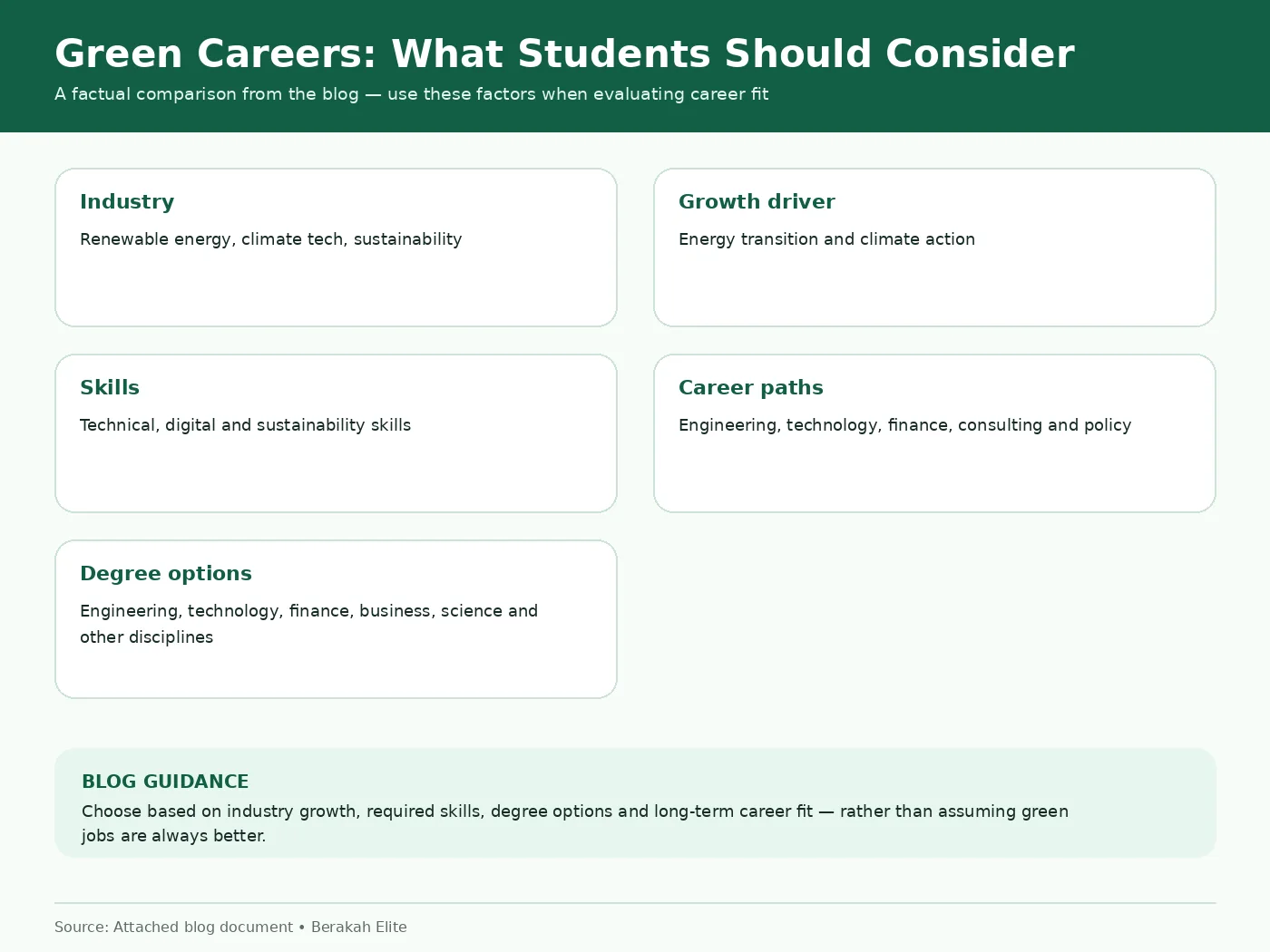
Green careers are growing across renewable energy, climate technology and sustainability. However, students should choose based on industry growth, required skills, degree options and long-term career fit, rather than assuming green jobs are always better.
FAQ
1. What are the fastest-growing green jobs in 2026?
Renewable energy engineers, environmental engineers, renewable-energy technicians and sustainability professionals are among the growing green roles. The WEF identifies renewable energy and environmental engineering roles among the fastest-growing occupations, while the IEA reports continued demand for skilled workers across energy sectors. WEF Future of Jobs Report IEA World Energy Employment 2025
2. Which degree is best for renewable energy jobs?
Electrical, mechanical, energy and renewable-energy engineering degrees can provide relevant renewable energy jobs abroad. Your choice should match your preferred area, such as solar, wind, grids or energy storage.
3. Can computer science graduates work in climate tech?
Yes. Computer science graduates can apply their skills in energy software, data analytics, smart grids and system optimisation, as digital technologies become increasingly important to modern energy systems.
4. Which degree is best for ESG careers?
Business, finance, economics, environmental studies and sustainability degrees can lead to ESG careers, depending on the role and specialisation.
5. Can Indian students get green jobs abroad?
Yes, but opportunities depend on their qualifications, skills, experience, work rights and employer requirements.
Conclusion
The green economy is creating career opportunities far beyond traditional environmental science. Students can enter green jobs abroad including ESG and climate tech through engineering, technology, finance, environmental science, business and other disciplines.
The key is to approach your study-abroad decision in the right order:
Degree → Skills → Industry Experience → Country → Career Pathway
Planning to study abroad for renewable energy careers, sustainability or climate tech? Berakah Elite can help you compare courses, universities and study destinations based on your academic profile and career goals.

Recent updates

Student Visa Rules in 2026: Latest Updates Every Indian Student Should Know
August 10 2026

Best Cities in New Zealand for Indian Students in 2026: Jobs, Rent, Student Life & Part-Time Opportunities
August 6 2026

AI-Proof Careers Abroad: Degrees That Will Stay Relevant Beyond 2030
July 13 2026
Global Talent Shortage Report 2026: Courses Leading to the Highest-Demand Jobs Abroad
July 11 2026

Study Abroad vs Skill-Based Migration: Which Route Offers Better Career Growth in 2026?
July 8 2026

Countries That Allow International Students to Bring Dependents in 2026
July 4 2026

Top AI, Cybersecurity & Healthcare Courses Abroad in 2026: Salaries, Career Growth & Best Countries
June 15 2026

Top Countries Offering Post-Study Work Visas for Indian Students in 2026
June 13 2026

Why Indian Students Are Choosing Europe Over Canada in 2026
June 11 2026