October 14 2026
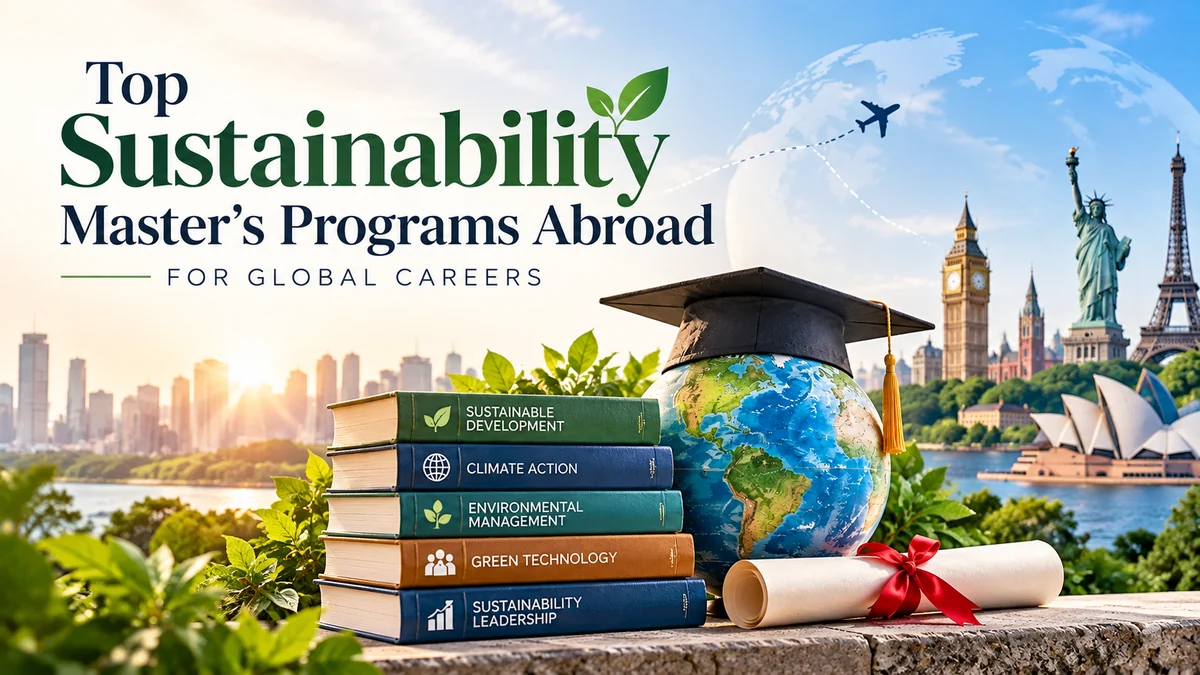
Top Sustainability Master’s Programs Abroad for Global Careers
Top Sustainability Master’s Programs Abroad for Global Careers
Introduction
Looking to turn your interest in sustainability into a rewarding global career? As organisations work to reduce their environmental impact and governments strengthen climate action, sustainability is becoming a business priority. This change is creating opportunities in renewable energy, ESG, sustainable finance, environmental management, and climate policy.
The demand for green skills is also growing faster than their availability. According to LinkedIn’s Global Green Skills Report 2025, demand for green hires grew by 8% over the previous two years, while the supply of green skills increased by just 4%. This gap highlights the growing importance of developing relevant expertise for the green economy.
For graduates and early-career professionals, a master’s degree abroad can provide specialised knowledge, practical experience and international exposure. Exploring the right master’s courses for sustainability careers abroad can help you choose a programme that aligns with your interests and prepares you for opportunities in the global sustainability sector.
Why Study Sustainability Abroad?
Pursuing a master’s in sustainability abroad exposes you to global approaches to climate action, clean energy, environmental management and ESG practices. International programmes also offer opportunities to gain practical experience through industry projects, internships and professional networks.
The growing energy sector highlights the potential of this field. According to LinkedIn’s Global Green Skills Report 2025, demand for green talent continues to grow faster than the availability of green skills. The report highlights an 8% increase in demand for green hires compared with a 4% increase in the supply of green skills over the period analysed. This gap highlights the importance of developing relevant sustainability expertise to prepare for opportunities in the growing green economy.
Countries such as the UK, Germany, Canada and Australia also offer post-study work routes for eligible graduates. Since visa rules and eligibility requirements vary, check the latest guidelines on official government websites before applying.
https://www.iea.org/reports/world-energy-employment-2024
What Makes a Sustainability Master’s Worth It?
A strong sustainability programme should combine academic knowledge with practical skills that employers can apply to real-world environmental and business challenges.
Curriculum and Specialisation Depth
Look beyond the course title to understand what you will learn. Relevant subjects may include climate policy, life-cycle assessment, carbon accounting, circular economy, environmental impact assessment, renewable energy and ESG reporting. Choose a curriculum that supports your intended career rather than relying on the sustainability label alone.
Industry Links, Internships and Employability
Prioritise universities offering industry-led projects, internship opportunities, research partnerships or practical case studies. Examine published graduate employment data and identify the roles alumni actually enter. These details provide a more useful indication of career relevance than general employability claims.
Accreditation and University Reputation
Check the university’s academic standing, programme recognition, faculty expertise, research facilities and professional partnerships. For specialised fields such as finance or engineering, relevant professional accreditation may also matter.
Cost, Scholarships and Funding
Compare tuition fees, living expenses, insurance, visa costs and other expenses across destinations. Explore university scholarships, government-funded awards and country-specific funding opportunities for international students. A shorter programme may reduce living costs, but the overall value depends on tuition, course quality and career outcomes.
Best Master’s Courses for Sustainability Careers
The best master’s degree depends on whether you want to work in environmental protection, clean energy, sustainable finance, research or corporate strategy. The following programme types offer careers in sustainability.
1. MSc Sustainability or Sustainable Development
An MSc in Sustainability or a sustainable development master’s programme provides a broad understanding of environmental, social and economic challenges. It is suitable for graduates seeking an interdisciplinary foundation rather than a narrowly technical qualification.
Typical modules include sustainable development, circular economy, climate policy, environmental economics and sustainability assessment. Depending on the curriculum, graduates may pursue roles such as sustainability consultant, sustainability analyst, programme officer or NGO project coordinator.
Best for: Graduates interested in sustainability consulting, development organisations and cross-sector environmental initiatives.
2. MSc Environmental Management or Environmental Policy
An environmental management master’s focuses on managing environmental risks, implementing regulations and improving the environmental performance of organisations. Environmental policy programmes place greater emphasis on governance, legislation and policy analysis.
Common subjects include environmental impact assessment, pollution control, natural resource management, environmental law and environmental auditing. Career options include environmental consultant, environmental compliance specialist, policy analyst and environmental management officer.
Best for: Students interested in environmental regulation, public policy, resource management and corporate environmental compliance.
3. MSc Renewable Energy or Energy Transition
For students interested in the transition away from fossil fuels, renewable energy programmes offer technical and industry-focused learning. Depending on the degree, the curriculum may cover solar and wind energy, energy storage, power systems, energy economics and renewable project development.
Graduates may work in renewable energy companies, utilities, engineering consultancies and clean technology businesses. Potential roles include renewable energy analyst, energy consultant, project development associate and energy transition specialist.
Best for: Graduates with relevant engineering, physics, energy or quantitative backgrounds.
4. MSc Sustainable Finance or ESG
An ESG master’s or sustainable finance degree explores how environmental and social considerations influence investment decisions, financial risk, corporate performance and reporting. It is particularly relevant as investors and businesses assess climate-related risks and sustainability disclosures.
Modules may include sustainable investment, ESG analysis, climate risk, responsible banking, sustainability reporting and green finance. Career opportunities include ESG analyst, sustainable investment analyst, climate risk analyst and sustainability reporting specialist.
Best for: Graduates from finance, economics, accounting, business and related analytical disciplines.
5. MBA or MSc in Sustainable Business or Corporate Sustainability
These programmes examine how organisations integrate sustainability into business models, operations, supply chains and long-term strategy. An MBA generally offers broader management training, while an MSc may provide deeper subject-specific knowledge.
Typical modules include sustainable operations, responsible supply chains, corporate governance, business strategy and sustainability performance measurement. Graduates may pursue roles in corporate sustainability, responsible sourcing, sustainability strategy and ESG programme management.
Best for: Business graduates and professionals aiming to combine management expertise with sustainability objectives.
6. MSc Climate Change or Climate Science and Policy
Climate-focused degrees examine the causes, consequences and mitigation of climate change. Some programmes emphasise climate modelling and scientific research, while others concentrate on adaptation, public policy and climate risk management.
Modules may include climate science, emissions modelling, climate adaptation, mitigation strategies and climate policy. Career options include climate policy analyst, climate risk consultant, research associate and climate programme specialist.
Best for: Graduates interested in climate research, policy development, climate risk or environmental advisory work.
Sustainability Master’s Programmes Compared
| Programme | Main focus | Best suited for | Potential career paths |
| MSC Sustainability | Interdisciplinary sustainability
| General sustainability careers | Consultant, analyst, programme officer |
| Environmental management | Environmental systems and compliance | Environmental and regulatory roles | Environmental consultant, compliance specialist |
| Renewable energy | Clean energy technologies and transition | Technical and energy sector careers | Energy analyst, project associate |
| Sustainable finance / ESG | Finance, risk and sustainability reporting | Finance and business graduates | ESG analyst, climate risk analyst |
| Sustainable business / MBA | Corporate strategy and operations | Management-oriented professionals | Sustainability manager, strategy associate |
| Climate change | Climate, adaptation and policy | Research and climate advisory candidates | Climate analyst, policy advisor |
Career titles and eligibility requirements vary by employer, country and programme. Technical, scientific and senior management roles may require additional qualifications or relevant experience.
Top Study Destinations for Sustainability Master’s Degrees
The right destination depends on your preferred specialisation, budget, language requirements and plans after graduation.
- Germany: Worth exploring for renewable energy, environmental engineering, climate research and energy transition programmes. Compare English-taught options with programmes requiring German proficiency.
- Netherlands: Offers opportunities to explore sustainability science, environmental governance, water management and circular economy.
- Sweden and Denmark: Particularly relevant for students interested in clean technology, sustainable urban development, energy systems and research-led education.
- United Kingdom: Offers a wide range of sustainability and ESG-related degrees, including many one-year master's programmes. Check the full cost of attendance and current graduate immigration rules.
- Canada: Provides options in environmental management, climate adaptation, natural resource management and sustainable development.
- Australia: Worth considering for environmental management, climate resilience, biodiversity and resource sustainability.
When shortlisting universities for master’s courses for sustainability careers abroad, review the curriculum, admission requirements, tuition fees, research facilities and industry partnerships. Verify programme details and visa requirements through official university and government websites before applying.
Examples of Sustainability Master’s Programmes Abroad
The following six university programmes offer different sustainability specialisations. Compare their curricula, entry requirements, duration and costs to identify options that match your career goals.
1. Smart Energy and the Built Environment MSc, University College London
University College London’s Smart Energy and the Built Environment MSc covers smart energy systems, renewable energy integration and energy management.
- Location: London, UK
- Duration: One year, full-time
- International tuition fee: £39,200 for 2026/27
- Entry requirements: A relevant bachelor’s degree or equivalent qualification. Applicants from other disciplines may be considered with relevant experience.
- Suitable for: Students interested in smart energy and sustainable buildings.
2. MSc Renewable Energy Technologies, University of York
The University of York’s MSc Renewable Energy Technologies explores renewable energy technologies, energy systems and related policies.
- Location: York, UK
- Duration: One year, full-time
- International tuition fee: £32,900 for 2026/27
- Suitable for: Students interested in renewable energy and the clean energy transition.
Check the official university websites for current entry requirements, fees and scholarship options, as these may change.
https://www.york.ac.uk/study/postgraduate-taught/courses/msc-renewable-energy-technologies/
3. MSc Sustainability, Environment and Development, University of Leeds
The University of Leeds offers an MSc Sustainability, Environment and Development focused on environmental, social and economic dimensions of sustainable development.
- Location: Leeds, UK
- Duration: Check the university’s current course page for the applicable study mode and duration.
- Suitable for: Students interested in sustainability policy, environmental development and interdisciplinary sustainability challenges.
https://www.york.ac.uk/study/postgraduate-taught/courses/msc-renewable-energy-technologies/
4. MSc Sustainability and Business, University of Leeds
The University of Leeds’ MSc Sustainability and Business explores how organisations can integrate sustainability into business practices and respond to environmental and social challenges.
- Location: Leeds, UK
- Duration: Check the current course page for the latest programme details.
- Suitable for: Students interested in corporate sustainability, responsible business and sustainable operations.
https://courses.leeds.ac.uk/g721/sustainability-and-business-msc
5. MSc Environmental Sustainability, University of Edinburgh
The University of Edinburgh’s MSc Environmental Sustainability takes an interdisciplinary approach to environmental sustainability and the challenges facing society.
- Location: Edinburgh, UK
- Duration: Check the university’s current course page for the applicable study mode and duration.
- Suitable for: Students interested in environmental sustainability, policy and research.
https://study.ed.ac.uk/programmes/postgraduate-taught/32-environmental-sustainability
6. MSc Environmental Sciences, Wageningen University
Wageningen University’s MSc Environmental Sciences combines natural and social sciences with technology to explore environmental issues such as pollution, biodiversity loss and resource depletion.
- Location: Wageningen, Netherlands
- Duration: Two years, full-time
- Language: English
- Suitable for: Students interested in environmental research, sustainability assessment and interdisciplinary environmental challenges.
https://www.wur.nl/en/education/master/masters-environmental-sciences
Tuition fees, entry requirements and programme availability may change. Verify the latest details on official university websites before applying. The UCL and York tuition figures above are for 2026/27 entry; fees for the other programmes should be confirmed directly with the universities.
How to Choose the Right Programme
Start by identifying your target role, then work backwards to select a suitable qualification. For example, ESG analysis may require finance and reporting knowledge, while renewable energy positions may demand technical expertise.
Compare programme duration, tuition fees, living costs, entry requirements, internship opportunities and graduate outcomes. Review visa and post-study work conditions through official government websites.
Before applying, shortlist two or three programmes and compare their total costs, course modules, admission criteria and scholarship deadlines. This can help you find options that suit both your career goals and budget.
Conclusion
A master’s degree abroad can help you develop specialised knowledge and explore opportunities in sustainability, renewable energy, environmental management and ESG.
Start by comparing master’s courses for sustainability careers abroad based on their curriculum, costs, entry requirements and career relevance. Choose a programme that aligns with your academic background, interests and long-term goals.
Connect with Berakah Elite for personalised guidance on selecting universities, understanding admission requirements and planning your study abroad journey. The team can help you explore programmes that match your academic background, career aspirations and budget.
FAQs
1.What is the best master’s for a sustainability career?
There is no single best option. MSc Sustainability suits broad career interests, while environmental management, renewable energy, sustainable finance and climate studies support more specialised programs.
2.Do I need a science background?
Not always. Some interdisciplinary sustainability and business programmes accept graduates from diverse academic backgrounds. Technical and research-focused degrees may require relevant science, engineering, mathematics or quantitative preparation.
3.Can I work abroad after a sustainability master’s?
Potentially, subject to the destination's immigration rules, eligibility criteria and employment requirements. Completing a degree does not automatically guarantee a work visa or job.
4.Are scholarships available for international students?
Yes. Universities, governments and external organisations offer scholarships and other funding opportunities. Eligibility, coverage, deadlines and application requirements vary.

Recent updates

AI Is Changing University Admissions: How Students Can Build an Application That Still Stands Out
September 23 2026
Scholarships for Indian Students in 2026: Funding Opportunities You Should Know About
September 23 2026
Study Abroad Without the Big Four: Which Emerging Destinations Are Gaining Indian Students in 2026?
September 17 2026
Green Jobs Abroad in 2026: Which Degrees Can Lead to Careers in Renewable Energy, ESG & Climate Tech?
September 16 2026
Student Visa Rules in 2026: Latest Updates Every Indian Student Should Know
August 10 2026
Best Cities in New Zealand for Indian Students in 2026: Jobs, Rent, Student Life & Part-Time Opportunities
August 6 2026
AI-Proof Careers Abroad: Degrees That Will Stay Relevant Beyond 2030
July 13 2026
Global Talent Shortage Report 2026: Courses Leading to the Highest-Demand Jobs Abroad
July 11 2026
Study Abroad vs Skill-Based Migration: Which Route Offers Better Career Growth in 2026?
July 8 2026