November 18 2026
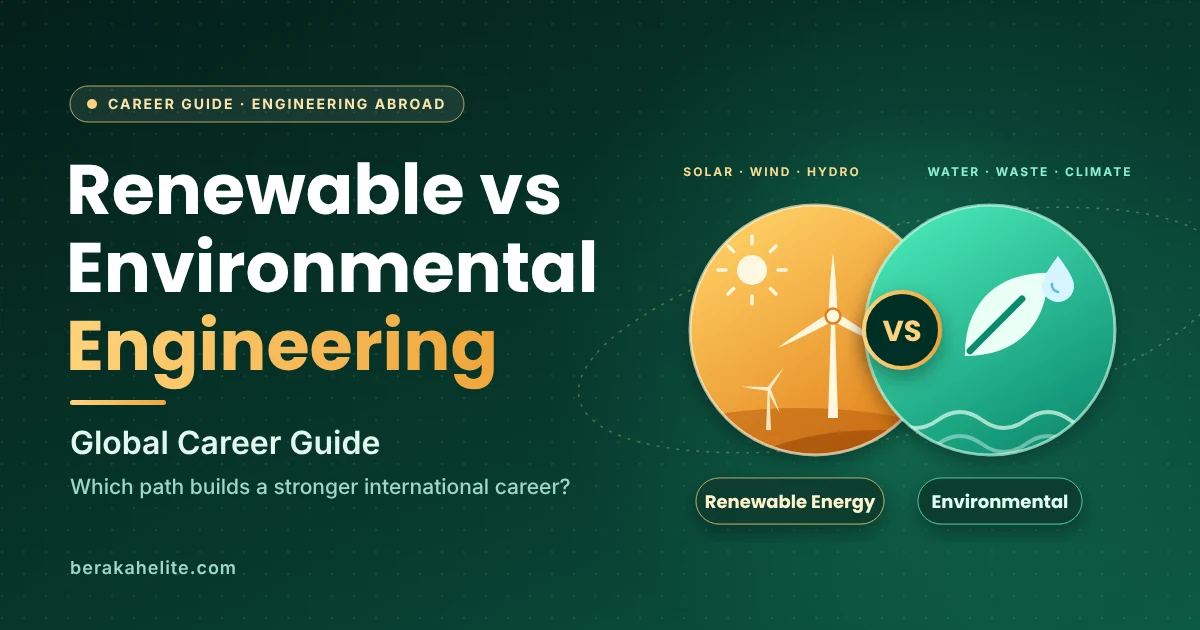
Renewable vs Environmental Engineering: Global Career Guide
You have earned your B.Tech degree and are ready to take the next step in your academic journey abroad. As you browse through different options, two fields might catch your attention: renewable energy engineering and environmental engineering. Both are connected to sustainability, but the kind of work they prepare you for is quite different.
The key difference between renewable energy engineering vs environmental engineering lies in their areas of focus. Renewable energy engineering focuses on clean power generation, energy systems and grid integration, while environmental engineering deals with pollution control, water and wastewater treatment, waste management and environmental compliance. If you enjoy designing energy systems and working with clean-energy technologies, renewable energy engineering may suit you.
If you'd rather work on water infrastructure, pollution prevention and environmental protection, consider environmental engineering. Let's compare their courses, career opportunities and prospects abroad to help you make an informed choice.
What Each Degree Actually Trains You For
The main difference lies in the engineering problems you will learn to solve.
Renewable energy
Renewable energy is focused on producing and managing energy from sources such as solar and wind. Depending on the programme, you will study subjects such as power electronics, energy storage, smart grids and renewable energy system design. These topics are covered in postgraduate power and energy engineering curricula at institutions such as Nanyang Technological University and the University of Stuttgart.
Note: The University of Stuttgart's Energy Engineering MSc is taught in German. Applicants must demonstrate sufficient German-language proficiency, although some individual modules are available in English.
https://www.uni-stuttgart.de/en/study/master-programs/energy-engineering-m.sc./program-structure/
Common career options include:
- Renewable Energy Engineer
- Solar or Wind Design Engineer
- Energy Systems Analyst
- Grid Integration Engineer
- Energy Modelling Specialist
Best suited to: EEE and Mechanical graduates interested in power systems, clean-energy technologies and energy infrastructure.
Environmental Engineering
Environmental engineering applies engineering principles to challenges such as water pollution, wastewater treatment, air pollution and waste management. Environmental Impact Assessment is another relevant area of study. These subjects feature in the M.Tech Environmental Engineering curriculum at IIT Bhubaneswar.
Common career options include:
- Environmental Engineer
- Water and Wastewater Treatment Engineer
- Environmental Consultant
- Environmental Impact Assessment Specialist
- Environmental Compliance Engineer
Best suited to: Civil and Chemical Engineering graduates interested in water infrastructure, pollution control and environmental protection. Admission requirements differ across universities, so check the prerequisites for each programme.
Can Environmental Engineers Work in Renewable Energy?
Yes. Environmental engineers can contribute to renewable energy projects through environmental impact assessments, site-related approvals and regulatory compliance. These responsibilities are relevant to project development, although the exact role depends on the employer and local regulations.
Renewable Energy Engineering vs Environmental Engineering: Key Differences
| Dimension | Renewable energy engineering | Environmental engineering |
| Core focus | Clean energy generation, power systems, energy storage and grid integration. | Pollution control, water treatment, waste management and environmental compliance. |
| Typical role | Renewable energy engineer, energy analyst, grid specialist | Environment engineer, water treatment engineer, environmental consultant |
| Relevant undergraduate backgrounds | EEE, electrical, mechanical | Civil, chemical, environmental |
| Technical skills | Power system, energy modelling, simulation and python | Water treatment design, GIS, environment modelling, and regulatory assessment. |
| Industries | Renewable energy, utilities, energy storage, and power equipment | Engineering consultancies, water utilities, infrastructure and environmental services. |
These are general recommendations, and eligibility requirements vary by university. Check the required undergraduate subjects before applying. If you are interested in both fields, consider hybrid programmes such as Sustainable Energy Systems or Energy and the Environment. Review the curriculum to ensure it provides the technical training needed for your preferred career.
What the Job Market Says
According to IRENA and the ILO, the global renewable energy sector employed 16.6 million people in 2024. However, employment growth slowed to 2.3%, despite record renewable energy capacity additions. Automation, manufacturing overcapacity and grid constraints contributed to this slowdown.
https://www.irena.org/Publications/2026/Jan/Renewable-energy-and-jobs-Annual-review-2025
Environmental engineering offers opportunities in water treatment, pollution control, environmental consulting and industrial compliance. Demand varies by country and infrastructure investment.
Before choosing a degree, check entry-level vacancies, required technical skills and language expectations in your target country. Neither degree guarantees a job abroad.
Which Countries Suit Which Degree?
Your choice of destination should depend on your specialisation, the universities available and the local job market. Here is a comparison of countries worth considering for renewable energy and environmental engineering.
| Country | Degree programs to explore | Key considerations |
| Germany | Renewable energy engineering, sustainable energy systems, environmental engineering | Strong engineering and clean energy industries. German language skills can improve access to local employment opportunities. |
| Denmark and Netherlands | Wind energy, renewable energy systems, environmental engineering | Relevant opportunities in wind energy, energy infrastructure, water management and environment technology. |
| United states | Environmental engineering, Renewable energy systems, energy engineering | Diverse engineering and consulting sectors. Eligible international graduates may qualify for a 24 month STEM OPT extension and it is subject to US immigration requirements and employer eligibility.
|
| United Kingdom | Renewable energy, environmental engineering, sustainable energy | Opportunities across energy infrastructure and environmental consulting. Check current post-study work employer sponsorship requirements. |
Denmark
Work in Denmark: Green Energy. Covers wind energy, district heating, solar energy and engineering career paths.
Work in Denmark: Engineering. Covers engineering and green energy industries.
Netherlands
Amsterdam: Renewable Energy and Cleantech. Covers renewable energy, hydrogen, smart grids and engineering opportunities.
EURES: Netherlands Labour Market. Provides labour-market information.
Germany: Renewable Energy and Engineering Systems
Germany is a good option for renewable energy, power systems and environmental engineering. Check course modules carefully, as some programmes focus more on policy than technical engineering. German language skills can improve job prospects. EU Blue Card eligibility depends on holding a recognised qualification, securing a qualifying job offer and meeting the applicable salary threshold. German language skills can also improve access to local employment opportunities.
https://www.make-it-in-germany.com/en/visa-recognition/visa-types/eu-blue-card
United States: Environmental Engineering and STEM Options
The US offers opportunities in environmental consulting, water infrastructure, remediation and energy engineering. Graduates of qualifying STEM programmes may be eligible for a 24-month STEM OPT extension, subject to immigration requirements. Check the official STEM OPT guidance.
United Kingdom, Denmark and Netherlands
These countries offer postgraduate options in renewable energy and environmental engineering. Compare course modules, practical training, entry-level vacancies and language requirements. Also check whether your intended role requires professional registration.
How to Choose: Four Questions to Ask Yourself
Before applying, answer these four questions.
1. What is your undergraduate branch?
- EEE or Electrical Engineering: Start with renewable energy, power systems, grid integration and energy storage programmes.
- Mechanical Engineering: Explore renewable energy systems, wind energy, energy conversion and thermal systems.
- Civil Engineering: Consider environmental engineering, water resources, wastewater treatment and infrastructure.
- Chemical Engineering: Explore environmental process engineering, pollution control, industrial sustainability and relevant energy technologies.
These are starting points, not fixed rules. Check each university's prerequisite subjects before applying.
2. What kind of engineering work do you prefer?
Do you want to design and optimise energy systems, model power generation or work on electrical infrastructure? Renewable energy engineering may be a better fit when exploring jobs abroad for engineers in the clean energy sector. Would you rather design water treatment processes, assess environmental impacts or solve pollution-related problems? Environmental engineering may offer a more suitable career path in these areas.
3. Which country and employment pathway are you targeting?
Research the industry clusters and entry-level vacancies in your intended destination. If you're targeting Germany, for example, check the demand for your specific engineering specialisation alongside German-language expectations. If you are considering the US, verify STEM OPT eligibility for the exact degree programme.
If long-term residence is a priority, research the current immigration rules independently. Admission to a course, eligibility for post-study work and eligibility for permanent residence are separate matters.
4. Would a hybrid degree give you more flexibility?
If you're interested in both fields, consider programmes in sustainable energy systems, energy and the environment or environmental and renewable energy management.
Read the curriculum before deciding. A programme with a broad sustainability focus may not provide the technical depth needed for a design engineering role. Look for modules, laboratory work, software training and projects that match your career goals.
Skills That Make Either Degree More Employable
A master's degree provides the foundation, but practical skills help you to stand out to employers.
Skills for Renewable Energy Engineers
- Energy modelling: Analyse energy output, efficiency and system performance.
- Power systems and grid integration: Understand how renewable sources connect to electricity networks.
- Simulation tools: Gain experience with MATLAB/Simulink and relevant energy modelling software.
- Python and data analysis: Evaluate energy production and operational performance.
Skills for Environmental Engineers
- Environmental Impact Assessment (EIA): Assess the environmental effects of projects.
- Water and wastewater treatment: Understand treatment processes and system design.
- GIS: Analyse geographical and environmental data.
- Environmental regulations: Understand compliance requirements and environmental standards.
Skills Useful in Both Fields
Data analysis, technical writing, project management and communication are valuable across both specialisations. Build practical experience through internships, academic projects or independent portfolio work. For example, you could model a solar energy system or evaluate a wastewater treatment process. These projects also give you relevant examples to discuss during interviews.
Conclusion
Choosing between renewable energy engineering vs environmental engineering comes down to your interests and career goals. If you are an EEE or Mechanical graduate interested in clean energy and power systems, consider renewable energy engineering. If you are from a Civil or Chemical background and prefer water management, pollution control or environmental infrastructure, environmental engineering may be a better fit.
Before applying for an MS environmental engineering abroad or a renewable energy programme, compare university curricula, check job opportunities in your target country and identify the skills employers expect. A master's degree can open career opportunities, but securing a job also requires practical skills and proactive networking.
Considering an international master's programme in engineering? Find the right engineering programme with guidance from Berakah Elite.
FAQs
1. Can an Electrical Engineering graduate pursue an MS in Environmental Engineering abroad?
Yes, some universities accept Electrical Engineering graduates for an MS in Environmental Engineering. Similarly, students exploring MS renewable energy abroad may find programmes that align with their Electrical Engineering background. However, eligibility depends on each university's admission requirements and prerequisite subjects. Check whether the programme requires previous coursework in environmental science, chemistry, fluid mechanics or related areas.
2. Are environmental engineering graduates in demand abroad?
Environmental engineering graduates can explore opportunities in water and wastewater treatment, pollution control, environmental consulting, waste management and regulatory compliance. However, demand varies by country, industry investment and local regulations. Relevant technical skills and practical experience can improve employment prospects.
3. Can renewable energy engineering graduates work in other engineering sectors?
Yes. Depending on their technical specialisation and experience, graduates may explore roles in power systems, energy infrastructure, utilities, energy storage and engineering consulting. Their opportunities will depend on the specific skills required by employers and the nature of the role.

Recent updates
ESG Careers Abroad: Degrees, Skills and Opportunities for Indian Students
November 18 2026
Can Computer Science Graduates Build Careers in Climate Tech?
October 14 2026

Top Sustainability Master’s Programs Abroad for Global Careers
October 14 2026

AI Is Changing University Admissions: How Students Can Build an Application That Still Stands Out
September 23 2026

Scholarships for Indian Students in 2026: Funding Opportunities You Should Know About
September 23 2026

Study Abroad Without the Big Four: Which Emerging Destinations Are Gaining Indian Students in 2026?
September 17 2026
Green Jobs Abroad in 2026: Which Degrees Can Lead to Careers in Renewable Energy, ESG & Climate Tech?
September 16 2026
Student Visa Rules in 2026: Latest Updates Every Indian Student Should Know
August 10 2026

Best Cities in New Zealand for Indian Students in 2026: Jobs, Rent, Student Life & Part-Time Opportunities
August 6 2026