June 13 2026
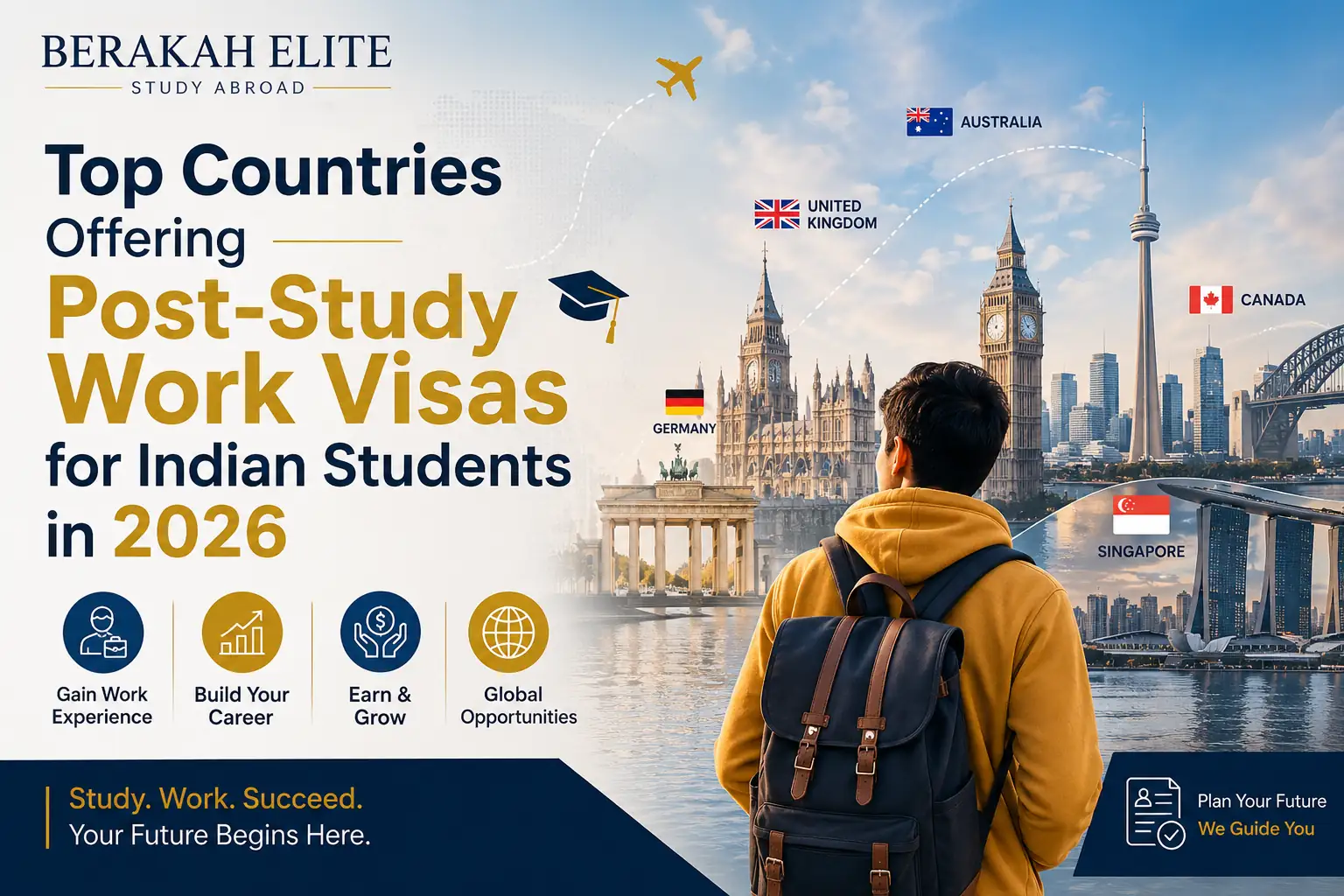
Top Countries Offering Post-Study Work Visas for Indian Students in 2026
Post-study work visas now play a major role in shaping study plans for Indian students in 2026, as they directly affect career options after graduation. Countries are adjusting rules like language proof, age limits and application timelines while still keeping work pathways open for graduates. This guide looks at leading destinations, comparing visa durations, costs, job opportunities, and recent updates to help students evaluate the post-study work visa for Indian students in 2026 and understand key options across different PSW visa countries.
Quick Comparison Table
The following comparison highlights post-study work visa options, visa duration, application fees and career advantages for international students in popular study destinations.
| Country | Visa Type | Typical Duration | Application Fee (INR approx.) | Best For |
| UK | Graduate Visa | 2 years (up to Dec 2026), 18 months (from 2027), PhD: 3 years | ₹1,11,217 + IHS ₹1,30,807/year | Strong job market and work-anywhere option |
| Canada | PGWP | Up to 3 years (based on program) | ₹16,469 | PR pathways and large Indian community |
| Australia | Subclass 485 | Varies by qualification | Varies | Strong graduate work rights |
| New Zealand | Post Study Work Visa | Up to 3 years | ₹92,187 | Simple process and faster approvals |
| Ireland | Stamp 1G | 12–24 months | ₹32,870 | Tech, finance, and EU job access |
| Netherlands | Orientation Year Visa | 1 year | ₹27,830 | EU access and open work rights |
| Germany | Job Seeker Visa | Up to 18 months | Varies | Engineering and tech opportunities |
| United States | OPT / STEM OPT | OPT / STEM OPT | Varies | High salaries, STEM careers, global companies |
Important Post-Study Work Visa Insights
UK Graduate Visa Rule Changes
The UK Graduate Visa duration will reduce from 2 years to 18 months from January 2027. For Indian students graduating in late 2026, timing matters significantly. Applying before the policy change can provide an additional six months of work rights, giving graduates more time to gain professional experience, secure sponsorship opportunities and improve long-term settlement prospects. Students planning UK admissions should therefore factor this deadline into their course selection and intake planning.
Canada's Language Requirement
Since language test scores are now an important requirement for many applicants, students should plan IELTS or CELPIP examinations well before graduation. Waiting until the final semester may create unnecessary delays and could affect application timelines. Early preparation helps avoid last-minute complications and improves the chances of a smooth PGWP application process.
Fees Alone Do Not Tell the Full Story
- Germany offers relatively low tuition costs but may require stronger German language skills for certain job opportunities.
- Canada provides clear pathways toward permanent residency, making it attractive for long-term settlement.
- The United States often involves higher education costs but can offer some of the highest graduate salary potential, particularly in STEM fields.
Looking beyond visa fees and evaluating salary prospects, employment opportunities, and long-term immigration pathways provides a more realistic picture of overall value.
India-Specific Advice
New Zealand offers transparent post-study work rules and relatively quick visa processing, but its job market is smaller than in countries like Canada, Australia, or the UK. Similarly, students relying on education loans may need to carefully plan language tests, visa applications, and employment timelines to manage financial commitments effectively.
Getting a work permit after studying in Canada depends on various factors, including the course length and the institution from which you graduated. Here are some of the factors that define your eligibility:
- You must have graduated from a Designated Learning Institution (DLI).
- You must have completed a full-time course in Canada for 8 months or more.
- You must have a valid student visa.
- You must have a transcript or official letter as proof that you have applied for a work permit visa within 180 days of completing your course.
Important PSW Visa Changes to Know in 2026
- Several popular study destinations have increased salary thresholds and tightened eligibility requirements for skilled migration pathways.
- Immigration policies are increasingly prioritising graduates whose qualifications align with occupations experiencing skills shortages.
- Competition for permanent residency pathways has intensified in Canada and Australia.
- The UK has announced that the Graduate Visa duration will be reduced from 2 years to 18 months for applications made from 1 January 2027.
- Canada now requires most PGWP applicants to provide proof of English or French language proficiency through approved tests such as IELTS, CELPIP or recognised French-language exams.
Country-Wise Guide to Post-Study Work Visas in 2026
Post-study work rules differ across countries in terms of duration, cost, and eligibility, which directly affect students' decisions in 2026. A closer look at each destination helps Indian students understand which pathway aligns better with career and immigration goals.
Canada – PGWP (Best for PR)
- Valid for up to 3 years, depending on the length and level of the study program.
- Applicants must graduate from an eligible institution and program.
- Applications must be submitted within the permitted period after completing studies.
- From November 2024, most applicants must provide proof of English or French language proficiency. Accepted tests include IELTS General Training, CELPIP General and approved French language tests.
- Canada continues to offer strong pathways to permanent residency and a large Indian community.
India Tip: Complete language tests early and prepare required documents before graduation to avoid delays in the PGWP application process.
UK – Graduate Visa (Fast Track Option)
- UK Graduate visa duration is 2 years (until Dec 2026), reduced to 18 months from Jan 2027; PhD holders get 3 years
- Processing time usually takes around 6-8 weeks
- Current costs include an application fee of £937 and an Immigration Health Surcharge (IHS) of £1,035 per year. For a standard 2-year Graduate Visa, the total IHS cost is £2,070
India tip: Students graduating in late 2026 may lose extra PSW months if they delay intake.
Australia – Subclass 485 Visa
- Duration varies based on qualification and updated July 2024 rules
- Eligibility will be decided based on age, qualification stream and occupation list
India tip: Keep track of immigration updates during the final semester for any rule changes
Ireland – Stamp 1G Route
- Allows 12 months for undergraduate and up to 24 months for postgraduate graduates
- Strong opportunities in IT, finance and analytics sectors
India tip: Work experience through internships improves job prospects significantly
New Zealand – Structured Pathway
- Offers post-study work rights for up to 3 years
- High approval efficiency with most applications processed within a month
India tip: Students should carefully align their course with in-demand job sectors, as the local job market is relatively small
United States – OPT & STEM OPT
- International students can apply for Optional Practical Training (OPT) after completing their degree.
- Standard OPT allows up to 12 months of work experience in the United States.
- Students in eligible STEM (Science, Technology, Engineering and Mathematics) programs may qualify for a 24-month STEM OPT extension, allowing up to 36 months of total work authorization.
- Work must be directly related to the student's field of study.
- The United States offers strong career opportunities, particularly in technology, engineering, healthcare, finance and research sectors.
India Tip: STEM graduates should explore employers that sponsor work visas and gain relevant internship experience during their studies to improve long-term career prospects.
FAQ
1. How long does a post-study work visa last?
Duration varies by country, such as the UK around 2 years, Canada up to 3 years, Australia depending on qualification, and New Zealand up to 3 years.
2. Do I need a job offer to apply?
No, most countries allow graduates to apply for a post-study work visa and search for jobs after completing their studies.
3. Can I work full-time during my PSW visa period?
Yes, in most countries graduates can work full-time for any employer during the visa validity period.
4. Can I extend my PSW visa?
Extensions are generally not available, but many countries allow switching to skilled work or residency pathways.
5. What documents are required?
Common documents include passport, student visa proof, degree certificate, academic transcripts, and financial records.
6. Is there an age limit for a PSW visa?
Most countries do not have strict age limits for post-study work visas. However, Australia generally requires most applicants for the Subclass 485 Temporary Graduate Visa to be 35 years old or younger at the time of application, although certain exceptions may apply.
7. Which country is best for PR?
Canada is often considered the strongest for PR pathways, followed by Australia and New Zealand depending on eligibility and occupation.
How to Choose the Best PSW Country in 2026
Choosing the right destination depends on course-to-job fit, budget and long-term career plans. With updated post-study work visa rules for Indian students in 2026, students should compare PSW visa countries based on visa duration, cost, job demand and PR opportunities. Missing key timelines like the UK 2027 PSW change can reduce work rights. Ready to take the next step? Book a consultation with Berakah Elite today and get expert guidance on choosing the right destination, securing your admission and maximising your post-study work opportunities for the 2026 intake.

Recent updates

Can Computer Science Graduates Build Careers in Climate Tech?
October 14 2026
Top Sustainability Master’s Programs Abroad for Global Careers
October 14 2026

AI Is Changing University Admissions: How Students Can Build an Application That Still Stands Out
September 23 2026
Scholarships for Indian Students in 2026: Funding Opportunities You Should Know About
September 23 2026
Study Abroad Without the Big Four: Which Emerging Destinations Are Gaining Indian Students in 2026?
September 17 2026

Green Jobs Abroad in 2026: Which Degrees Can Lead to Careers in Renewable Energy, ESG & Climate Tech?
September 16 2026
Student Visa Rules in 2026: Latest Updates Every Indian Student Should Know
August 10 2026

Best Cities in New Zealand for Indian Students in 2026: Jobs, Rent, Student Life & Part-Time Opportunities
August 6 2026

AI-Proof Careers Abroad: Degrees That Will Stay Relevant Beyond 2030
July 13 2026