February 5 2026
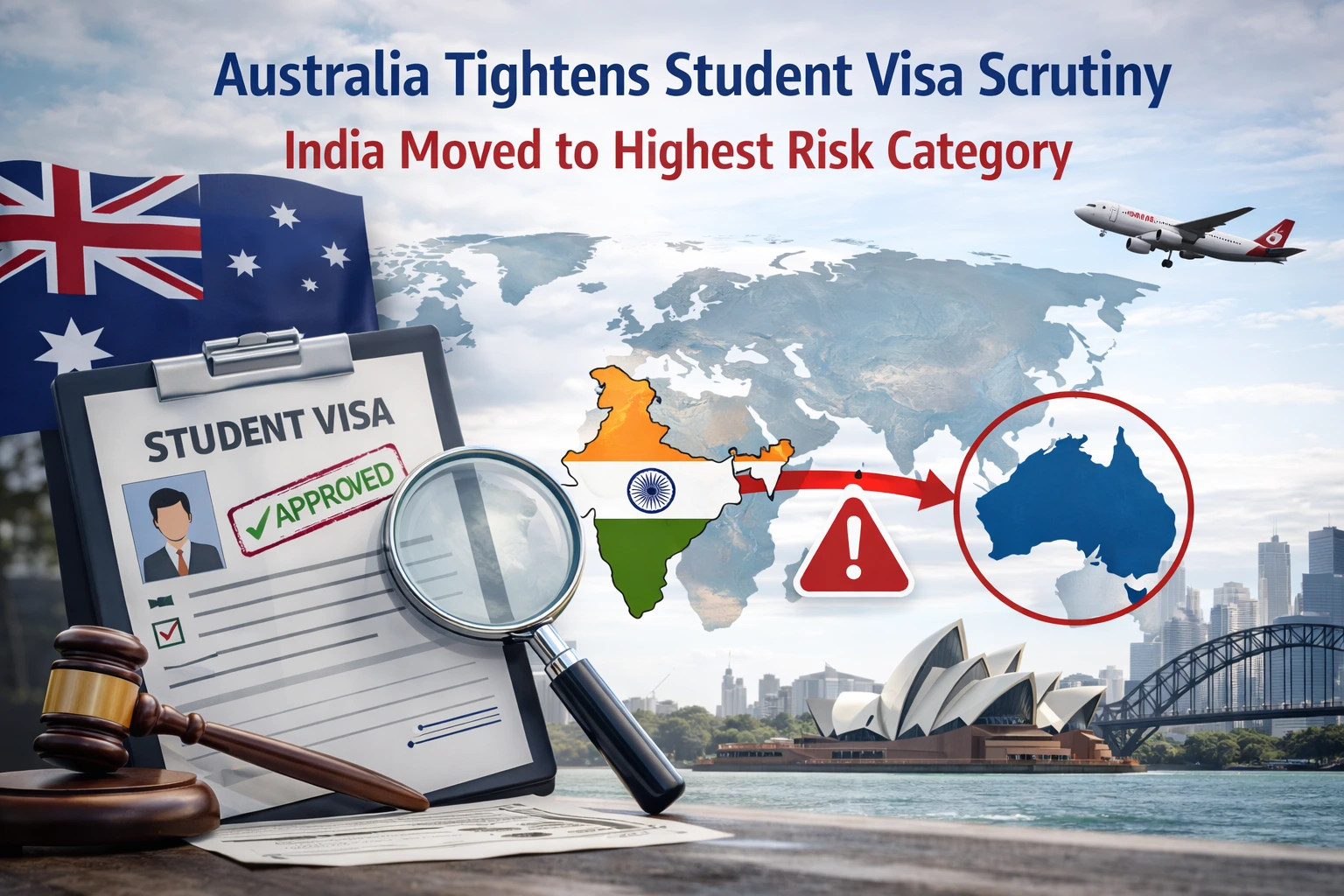
Australia Increases Student Visa Checks, India Placed in Highest Risk Category
Australia has introduced a major policy shift that directly impacts Indian students planning to study abroad. Australia tightens student visa scrutiny, effective January 8, 2026, when India moved to highest risk category Australia, shifting from Assessment Level 2 to Assessment Level 3. This change increases documentation, verification checks, and scrutiny for Indian applicants, making visa outcomes less predictable. In our findings, the move is driven by “emerging integrity issues” and rising fraudulent documentation trends, pushing India into the highest risk category. Australia tightens student visa scrutiny is a warning that only strong, compliant applications will succeed.
What Has Changed in Australia’s Student Visa Framework?
Australia has revised its student visa risk framework, moving India from Assessment Level 2 to Assessment Level 3 effective January 8, 2026. This shift increases documentation, deeper verification checks, and longer processing times for Indian applicants. Other South Asian countries like Bangladesh and Nepal are also affected, while Sri Lanka remains AL2. These changes are part of broader migration reforms and earlier tightening cycles in 2025–2026. Australia student visa changes 2026 aim to improve compliance and reduce non-genuine applications.
What Are Australia’s Student Visa Assessment Levels?
Australia’s student visa assessment levels rank countries based on risk, using refusal rates, compliance history, and fraud indicators. Higher levels trigger stricter document checks, financial proof, and longer processing times under Subclass 500. Country risk is combined with provider risk to determine the final scrutiny level. Australia student visa risk category India now requires stronger verification due to higher integrity concerns.
How the Risk Categorization System Works
The system combines country risk and education provider risk to decide evidence requirements. For a Subclass 500 visa, applicants must meet Genuine Student (GS) criteria, proving intent to study, plus financial capacity thresholds covering tuition, living costs, and travel. Higher risk categories trigger deeper verification through PRISMS and the Document Checklist Tool.
Role of PRISMS and Document Checklist Tool
PRISMS tracks enrolments, course progress, and visa compliance, while the Document Checklist Tool customises evidence requirements. Together, they align country risk, provider risk, GS assessment, and financial capacity checks to ensure only genuine, well-prepared students proceed.
How Country Risk + Provider Risk Combine
Country risk sets the baseline assessment level, while provider risk can raise or lower scrutiny. A low-risk university may reduce document demands, but high country risk still requires stronger GS explanations and financial proof under Subclass 500 rules.
Why Did Australia Move India to the Highest Risk Category?
Australia moved India to the highest risk category due to rising refusal rates, increasing fraud, and “emerging integrity issues” such as forged documents and inconsistent information. The shift to Australia Assessment Level 3 India strengthens verification, ensuring only genuine students meet the requirements and reducing misuse of the student visa system.
“Emerging Integrity Issues” Explained
“Emerging integrity issues” refer to patterns of falsified documents, misrepresented intentions, and inconsistent information that suggest applicants may not meet Genuine Student (GS) criteria, raising concerns about the credibility of visa claims and system abuse.
Rise in Fraudulent Documentation
A noticeable increase in fake academic transcripts, forged financial statements, and manipulated admission letters has driven tighter checks, with authorities demanding more rigorous proof to confirm authenticity and deter fraud.
Quality of Applications and Compliance Trends
Declining application quality and compliance breaches, including poor course attendance and visa condition violations, have influenced risk categorization. While education compliance audits intensify, similar tightening is seen in the UK and Canada, where policy reforms and caps are debated to manage student inflow and maintain standards.
What Does Assessment Level 3 Mean for Indian Students?
Assessment Level 3 means Indian students face stricter scrutiny under the Subclass 500 visa process. Australia student visa new rules for Indian students require stronger proof of funds, clearer sponsorship evidence, and more consistent documentation. English test results (IELTS/PTE) and Genuine Student intent are checked more closely, leading to higher chances of additional requests, delays, or refusals if information is inconsistent. A well-prepared SOP, strong financial evidence, and complete documents are essential to improve approval chances.
Impact on Indian Students and Australia’s Education Sector
Indian students are a major driver of Australia’s International education growth because they constitute about ~830,000 international students who study in the country while they bring in approximately AUD 51 billion from educational exports. Over the last 5–10 years, Indian students have increased their enrolment numbers which has improved campus diversity and financial support. However, the universities and agents demonstrate concerns about higher visa risk levels which will probably cause decreased enrolment numbers and extended processing times. Worldwide student visa regulations in Canada, the UK, and the US have become stricter which forces Australia to find a solution that maintains its competitive edge while ensuring system integrity. The industry leaders demand that the government develop precise policies which will ensure student safety and industry protection.
Will This Affect 2026 Intake Applications?
Yes, Australia’s July intake 2026 may face delays as processing times rise due to deeper verification checks and increased documentation requirements. The February intake Australia could also experience longer waits for CoE issuance and visa approval. These changes may add to the existing student visa backlog, creating uncertainty for students and institutions. Visa refusal rates may increase, and policy stability concerns remain until integrity issues are addressed. Whether this shift is temporary depends on future compliance trends and fraud reduction efforts. Australia student visa latest news 2026 indicates applicants should prepare early and apply carefully.
Comparison: Australia vs Other Major Study Destinations
Australia remains a top choice, but rising student visa scrutiny now aligns it with the UK, Canada, and the US in tougher checks and compliance requirements. While each destination strengthens integrity measures, Australia still offers quality education, safety, and strong career pathways, though applicants must be well-prepared and documented.
UK Student Visa Rules 2026
The UK continues tightening student visa rules with stricter financial, English, and sponsor checks. Applicants must prove genuine study intent and provide reliable documentation, especially from high-risk countries.
Canada Student Visa Caps
Canada is considering student visa caps to manage high enrolment growth and improve system integrity. Applicants now face stronger financial proof and compliance expectations, making authentic documentation essential.
US F1 Visa Scrutiny
The US maintains rigorous F1 scrutiny focusing on non-immigrant intent, clear academic goals, and strong funding proof. Applicants from higher-risk regions may undergo deeper verification, requiring consistent and transparent documentation.
Is Australia Still Competitive?
Australia remains competitive due to its high-quality education, safety, and post-study work opportunities. However, Assessment Level 3 means stronger preparation and compliance are crucial for success, especially for students from higher-risk countries like India.
How Indian Students Can Strengthen Their Student Visa Application
To improve chances under Assessment Level 3, Indian students should prepare complete, credible evidence before applying. Strong financial documentation, a clear Genuine Student (GS) statement, and choosing reputable providers are essential. Avoid rushing the process, ensure every document meets DHA standards, and consider using registered education consultants for guidance. This reduces the risk of delays, refusals, and back-and-forth requests.
Ensure Strong Financial Documentation
- Provide clear proof of funds such as bank statements, fixed deposits, and education loan documents.
- Show consistent funds over time and credible income sources.
- Include proper sponsorship details and translated/certified documents if needed.
- Under higher risk levels, DHA may request additional evidence, so aim for transparency.
Prepare a Clear Genuine Student Statement
- Explain why you chose the course and how it fits your background.
- Highlight your future career plans in India and relevance of the course.
- Mention reasons for choosing Australia and your funding sources.
- Avoid vague language and address any education or work gaps.
Choose Reputed Education Providers
- Select registered, well-established providers with strong compliance records.
- Verify course relevance, outcomes, and student support services.
- Avoid low-quality or short-term institutions that may raise suspicion.
- A reputable provider also helps ensure a smooth CoE process.
Avoid Last-Minute Applications
- Apply early to prevent rushed documentation and missing evidence.
- Early submission reduces the risk of delays or refusal.
- Allows time for verification, arranging finances, and improving your GS statement.
- Improves the chance of timely approval for your chosen intake.
Work With Registered Education Consultants
- Use registered consultants to ensure your application meets DHA standards.
- Consultants guide course selection, documentation, and GS statement preparation.
- Choose consultants registered with credible bodies and avoid unverified agents.
- Professional support reduces errors and increases approval chances under higher risk levels.
Expert Opinions and Sector Reactions
Industry voices, including the IEAA, warn that moving India to the highest risk level may strain Australia’s international education market. Education agents express concern about stricter documentation and longer processing times, while universities worry about enrolment drops and planning uncertainty. Stakeholders also highlight policy transparency gaps, saying communication has been unclear and timelines unpredictable. This fuels market unpredictability and adds to the broader migration reform debate, with experts urging clearer guidance to protect Australia’s education reputation and economic stability.
What Happens Next? Possible Future Scenarios
Australia's decision might only serve as a short-term risk adjustment while leaving open possibilities for India to reassess its risk status when compliance improvements take place. The Australia–India education partnership together with its extended educational diplomatic efforts will become essential to their existing student mobility agreements. The educational relationship between the two countries will face temporary obstacles, but their educational sector lobbyists and ongoing diplomatic talks will help restore trust and maintain their academic partnership and student exchange programs.
Frequently Asked Questions (FAQ Section for Featured Snippets)
- Why did Australia move India to Assessment Level 3?
Australia shifted India to AL3 due to higher visa scrutiny based on risk indicators such as refusal rates and compliance concerns. - Does AL3 mean Indian students cannot study in Australia?
No, Indian students can still study in Australia, but they may face stricter documentation and assessment requirements. - Will student visa processing time increase in 2026?
Yes, processing times may be longer as applications under AL3 undergo more detailed verification. - What documents are required under AL3?
Applicants typically need stronger financial proof, academic records, English proficiency evidence, and genuine student documentation. - Is Australia still safe for Indian students?
Yes, Australia remains a safe and welcoming destination with strong support systems for international students. - Can the assessment level change again?
Yes, assessment levels are regularly reviewed and can be upgraded or downgraded based on ongoing risk assessments and data.
Conclusion: Australia Remains Open, But Compliance Is Now Critical
As Australia tightens student visa scrutiny, the move reflects risk management rather than closure after India moved to highest risk category Australia under Assessment Level 3. For Australia student visa 2026, students must focus on accuracy, transparency, and readiness to meet enhanced student visa scrutiny. With India in the India highest risk category, expert guidance is crucial. Berakahelite, the best study abroad consultants in Kerala and trusted Overseas education consultants in Kerala, ensures confident applications and compliance.
Get in Touch Today with Berakahelite to unlock expert counselling, quicker approvals, complete compliance support, and a free call back from experts—your global education journey starts here.

Recent updates

AI Is Changing University Admissions: How Students Can Build an Application That Still Stands Out
September 23 2026
Scholarships for Indian Students in 2026: Funding Opportunities You Should Know About
September 23 2026

Study Abroad Without the Big Four: Which Emerging Destinations Are Gaining Indian Students in 2026?
September 17 2026

Green Jobs Abroad in 2026: Which Degrees Can Lead to Careers in Renewable Energy, ESG & Climate Tech?
September 16 2026
Student Visa Rules in 2026: Latest Updates Every Indian Student Should Know
August 10 2026

Best Cities in New Zealand for Indian Students in 2026: Jobs, Rent, Student Life & Part-Time Opportunities
August 6 2026

AI-Proof Careers Abroad: Degrees That Will Stay Relevant Beyond 2030
July 13 2026

Global Talent Shortage Report 2026: Courses Leading to the Highest-Demand Jobs Abroad
July 11 2026

Study Abroad vs Skill-Based Migration: Which Route Offers Better Career Growth in 2026?
July 8 2026