February 6 2026
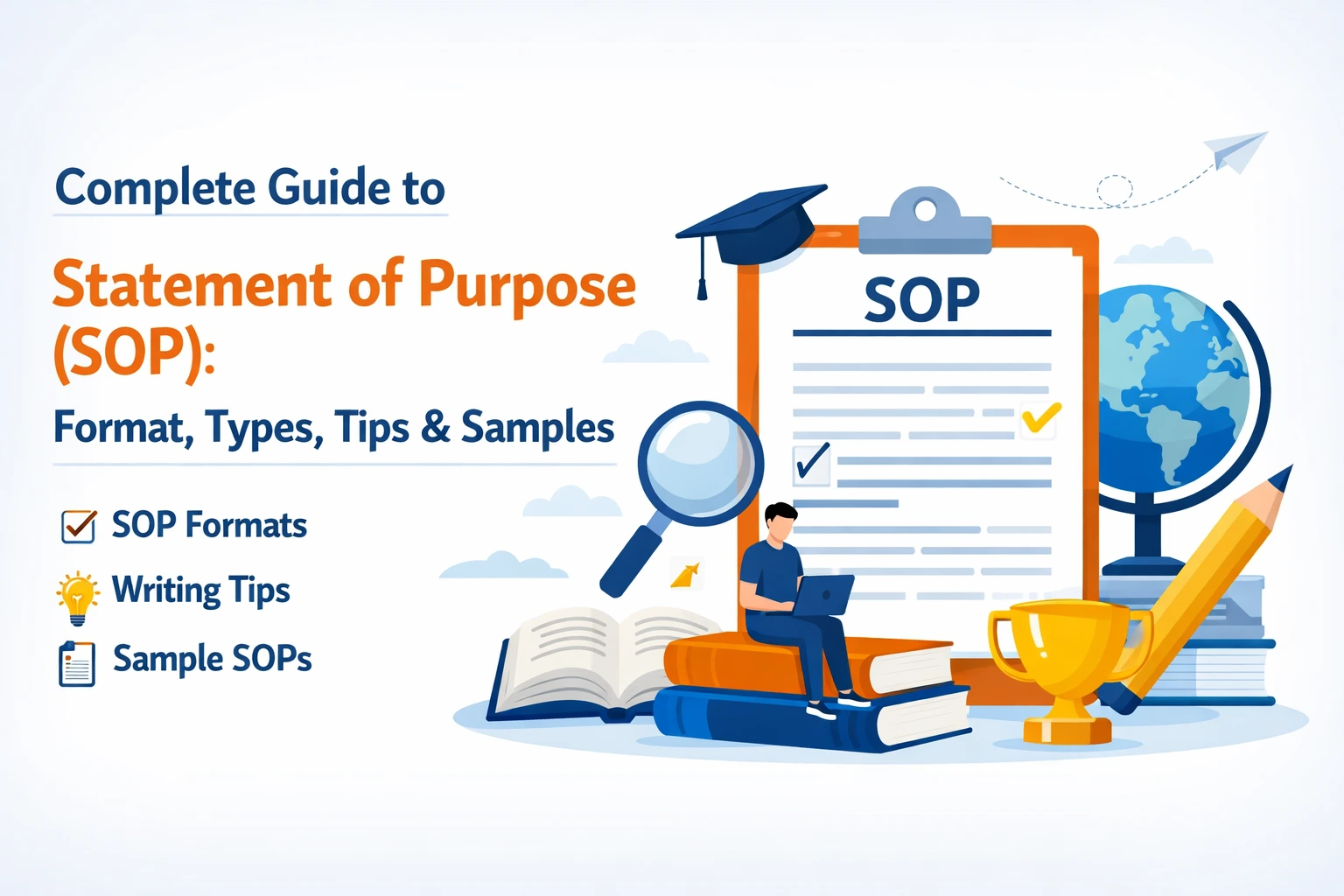
The Ultimate Guide to Writing a Statement of Purpose (SOP): Format, Types, Tips & Examples
A statement of purpose guide is essential for students applying to competitive universities where academic scores alone cannot secure admission. Institutions use the SOP to evaluate intent, clarity, and readiness through the admissions committee’s detailed assessment. It plays a major role in holistic application review by highlighting motivation, academic focus, and future direction beyond GPA and test results. For international students, the SOP is a critical part of the study abroad application process, explaining academic background, program choice, and long-term goals with credibility and purpose.
What is a Statement of Purpose (SOP)?
Statement of purpose is a structured academic document explaining background, motivation, academic preparation, and future objectives, helping universities assess suitability, intent, and alignment with program outcomes during application evaluation stages.
SOP Full Form and Meaning
SOP stands for Statement of Purpose and represents an applicant’s formal explanation of academic interests, preparation, and objectives, written to support a graduate school application through a coherent academic narrative.
Difference Between SOP, Personal Statement & Letter of Motivation
An SOP focuses on academic and career intent, a personal statement highlights life experiences, while a motivation letter briefly explains reasons for applying, commonly used in European admission systems.
SOP vs Resume vs LOR
An SOP explains purpose and direction, a resume lists qualifications chronologically, and an LOR validates abilities through external endorsement, together forming a complete application essay portfolio.
Why is a Statement of Purpose Important for Admission?
Statement of Purpose for study abroad is your strongest tool to communicate academic intent and career goals beyond grades. It helps universities understand your motivation, readiness, and long-term vision. Especially for international applications, a well-written SOP proves your seriousness, clarifies program fit, and shows you can succeed in a new academic environment. Strong SOPs can significantly improve admission chances in competitive programs.
Types of Statement of Purpose
Different academic and professional goals require tailored SOP formats, and understanding the types of statement of purpose helps applicants customize tone, structure, and focus. This improves clarity, relevance, and evaluation outcomes across various admission and visa scenarios.
Admission SOP
An admission SOP helps universities evaluate applicant readiness through academic preparation assessment and coursework relevance measurement and project evaluation and goal accomplishment tracking.
Visa SOP (GTE / GS Based)
The visa SOP document describes study intentions, shows financial ability to pay for studies, explains how courses relate to studies, and describes future career objectives, which enables authorities to assess the applicant's trustworthiness and study purpose and their compliance with visa requirements.
MBA SOP
An MBA SOP assessment requires evaluation of professional experience along with leadership skills and decision-making abilities and career development plans, which connect the learning requirements of managers to the program design and their future career goals.
PhD / Research SOP
A PhD statement of purpose documents research interests and methodological skills while demonstrating faculty compatibility and future academic work which the applicant intends to pursue. The document functions as an initial research proposal which builds on their existing academic knowledge.
Undergraduate SOP
An undergraduate SOP shows his academic research interest, specific subject preference, initial educational experience and his dedication to learning through his academic work. The statement shows his readiness to succeed in academic programs which require structured study and maintain academic growth.
Scholarship SOP
The scholarship SOP shows that the applicant needs financial support because they must demonstrate their academic achievements their impact on others and their ability to manage funds and their expected future contributions.
Internship / Job SOP
An internship or job SOP establishes the required skills together with the learning objectives which must be achieved by the candidate who will perform particular job responsibilities of the position. The statement describes how the opportunity will help the applicant develop their career while they contribute to the organization.
Comparison Table: Types of Statement of Purpose
| Type | Purpose | Tone | Word Count | Evaluation |
|---|---|---|---|---|
| Admission | Program entry | Academic | 800–1000 | Fit |
| Visa | Study intent | Formal | 700–1000 | Credibility |
| MBA | Career growth | Professional | 800–1000 | Leadership |
| PhD | Research | Technical | 1000+ | Alignment |
Ideal SOP Word Count & Formatting Guidelines
Understanding the SOP format ensures proper font, spacing, and structure, helping your document look professional and meet university requirements while improving readability for admissions committees.
Standard Word Count by Country
Different countries expect varying SOP lengths, so applicants must follow specific guidelines. Typically, the USA prefers 800–1000 words, the UK 600–900, Canada 800–1000, Australia 700–1000, and Europe 500–800 words depending on the university.
Formatting Rules (Font, Spacing, Margins)
Use standard fonts like Times New Roman or Arial in 11–12 pt size, with 1.15 or double spacing and 1-inch margins. Consistent formatting improves readability, looks professional, and helps evaluators focus on content rather than layout issues.
Paragraph Structure Best Practices
Each paragraph should cover one idea with a clear topic sentence, supporting details, and a transition sentence. The SOP achieves smooth reading through its logical flow and sentence spacing which connects all parts of the document to create continuous reader engagement.
Country-wise Word Count Table (Value Add)
| Country | Typical SOP Length |
|---|---|
| USA | 800–1000 words |
| UK | 600–900 words |
| Canada | 800–1000 words |
| Australia | 700–1000 words |
| Europe | 500–800 words |
The word limits for competitive programs must be followed because any deviation from these limits will result in negative assessment results. The PDF format should be submitted when it is permissible because this format maintains document layout; when only text format is needed, the writer must use clean paragraph spacing while avoiding bullet points and table elements and special fonts.
Step-by-Step SOP Structure (Proven 7–8 Paragraph Framework)
This proven framework shows how to write SOP effectively by organizing your story into clear paragraphs, ensuring strong flow, relevant examples, and convincing alignment with your chosen program.
1. Engaging Introduction (Hook Strategy)
Begin your writing with a detailed description of your most challenging moment which created your current field of interest. Your writing should create reader interest while demonstrating your unique character traits and your main driving force. The reader should become interested in understanding how your passion developed into specific educational objectives.
2. Academic Background
You need to explain the complete path of your academic progress together with all the important courses you completed and major accomplishments. Your educational experience needs to be demonstrated through your development of interests and abilities and your desire to conduct research. You should demonstrate how your educational background supports your application to the program you want to join.
3. Projects & Technical Exposure
Present 1 to 2 major projects which include research work and technical work. Describe your responsibilities and the tools you utilized and the results you achieved and the knowledge you acquired. Your experiences exhibit problem-solving skills and innovative thinking which prepared you for higher education.
4. Work Experience / Internships
You need to review your work experience through relevant internships or jobs which include your job duties and actual effects of your work performance. The demonstration of your development together with your ability to work with others and your growth as a professional must be shown. Your academic interests should be connected to your experiences which helped shape your career path.
5. Key Skills & Achievements
List technical and soft skills with proof through achievements, awards, or certifications. Demonstrate how your strengths support your success in the program. Ensure relevance to the course modules and industry expectations.
6. Why This Course?
Explain how the program’s structure matches your academic interests and professional goals. Mention specific modules, labs, or faculty areas. Show clear alignment between what you want to learn and what the course offers.
7. Why This University?
Highlight university strengths, culture, research facilities, and community. Mention professors, labs, and unique resources. Show you researched thoroughly and that the institution is the best fit for your growth.
8. Career Goals (Short-term & Long-term)
Define clear short-term goals after graduation and long-term professional aspirations. Show a logical path from education to career impact. Align goals with industry needs, societal value, and your personal mission.
9. Conclusion with Purpose & Commitment
Summarize your story and reinforce your motivation. Reaffirm readiness, commitment, and fit for the program. End with a confident statement of purpose and a forward-looking vision.
Enhancements
Transition Tips Between Paragraphs
Use phrases like:
- “Building on this foundation…”
- “This experience led me to…”
- “Consequently, I became interested in…”
- “To deepen my understanding…”
- “This motivated me to pursue…”
Storytelling Formula (Past → Present → Future)
- Past: Foundation + key experiences
- Present: Current skills + academic direction
- Future: Goals + impact + why the university
Country-Specific SOP Requirements (USA, UK, Canada, Australia & More)
Different countries evaluate SOPs using varied academic and compliance priorities, requiring applicants to adapt tone, structure, and emphasis accordingly.
SOP for USA
Highlight your research potential, leadership experience, and innovative mindset. Showcase academic achievements, projects, and future impact on your field and university community.
SOP for UK
Focus on academic clarity and strong course motivation. Explain why the program fits your goals and how its modules align with your interests.
SOP for Canada
Balance career clarity with immigration intent, demonstrating a realistic post-study plan. Emphasize practical training, work experience, and contribution to the Canadian job market.
SOP for Australia
Ensure GTE/GS compliance by showing genuine study intent and clear future goals. Highlight course relevance and how it supports your professional growth.
SOP for Germany & Europe
Show technical depth, academic rigor, and concise writing. Highlight research experience, projects, and practical skills that fit the European education system.
SOP for Ireland & New Zealand
Focus on clear course motivation, practical learning outcomes, and career relevance. Highlight how the program supports professional growth, and demonstrate strong academic fit and genuine intent to study and contribute.
How to Start an SOP (With Real Hook Examples)
Starting your SOP with a powerful hook sets the tone for the entire story. You can begin with a problem-solving hook like fixing a critical software bug under pressure, a research curiosity hook sparked by a surprising discovery, an industry experience hook from an internship where you drove real impact, or an academic breakthrough moment when a concept clicked and changed your perspective. These opening styles instantly engage the reader and clearly show your motivation, setting up a strong, memorable introduction.
How to Write Career Goals in SOP
Craft clear, compelling short-term and long-term goals that show direction, ambition, and impact. Align them with your chosen course and professional development, proving your readiness and purpose for graduate study.
Writing Short-Term Goals
Define what you aim to achieve immediately after graduation, such as specific roles, industries, or skills you want to build. Make your goals realistic, measurable, and directly tied to your program.
Writing Long-Term Vision
Describe your broader professional aspirations and the impact you want to create in your field. Show how your long-term vision evolves from your short-term goals and reflects your personal mission.
Aligning Goals with Course
Explain how the program’s modules, projects, and resources will bridge your current skills to your future goals. Mention specific course elements that directly support your career path and professional development.
Common SOP Mistakes (Expanded Version)
Many SOPs get rejected due to copy-paste templates, AI-generated generic tone, or plagiarism. Over-exaggeration and weak conclusions reduce credibility, while lack of program research shows poor fit and commitment. Grammar and structural issues make the SOP difficult to read, and being too emotional or too robotic prevents genuine connection. To avoid common mistakes in your statement of purpose, focus on authenticity, clarity, and strong alignment with the chosen program.
SOP Writing Checklist Before Submission
Before submitting your SOP, confirm your word count meets the university’s limit and the university name is accurate. Ensure you’ve mentioned relevant modules and clearly outlined your career path, showing how the program supports your goals. Proofread at least three times for grammar, clarity, and flow, and run a plagiarism check to ensure originality. Make sure the SOP is personalized for the specific university, reflecting genuine motivation and strong fit with its culture, faculty, and resources.
How to Strengthen Weak Profiles in SOP
To strengthen a weak profile, clearly explain academic gaps with honest context and lessons learned. Justify a low GPA by highlighting improved performance, extra coursework, or skill-building projects. For career switches, show a logical transition, transferable skills, and genuine motivation for the new field. Address backlogs transparently, emphasizing responsibility and consistent improvement. A strong SOP turns weaknesses into proof of resilience, growth, and readiness for the next step.
Should You Take Professional SOP Help?
Considering professional SOP help can boost quality, clarity, and structure, especially if you struggle with writing or need strong storytelling. Editing services improve your draft without changing your voice, while ghostwriting risks misrepresentation and ethical issues. Universities expect originality and personal authenticity, so avoid outsourcing the core content. If you choose help, use it for guidance, proofreading, and polishing rather than full writing.
Frequently Asked Questions (FAQ Schema Section)
- What is the ideal word count for SOP?
The ideal SOP length is usually 500–1000 words. - Can I use same SOP for all universities?
No, each SOP should be customized for the specific university and course. - Is SOP required for visa?
SOP is often required for student visas, especially in countries like Canada and Australia. - How long does it take to write SOP?
Writing a strong SOP typically takes 3–7 days. - Should SOP be formal or conversational?
Your SOP should be formal yet personal and engaging. - Can ChatGPT write SOP? (High volume query)
Yes, ChatGPT can draft an SOP, but it should be edited and personalized by you.
Conclusion: Your SOP Is Your Academic Identity
Statement of purpose guide should reflect your true academic identity, showcasing authenticity and a structured narrative that clearly connects your past, present, and future goals. Write with clarity, strong transitions, and a logical flow that highlights your strengths and motivations. Preparation is crucial—research the program thoroughly, tailor your SOP, and proofread carefully to ensure it stands out. For expert support and personalized guidance, Berakahelite is the top Abroad Study Consultancy in Kochi, helping you craft a compelling and genuine SOP.
Get in Touch Today with Berakahelite for fast, personalized SOP guidance. Our experts will call you back to help unlock your dream admission—step into your global future with confidence.

Recent updates

Can Computer Science Graduates Build Careers in Climate Tech?
October 14 2026
Top Sustainability Master’s Programs Abroad for Global Careers
October 14 2026

AI Is Changing University Admissions: How Students Can Build an Application That Still Stands Out
September 23 2026

Scholarships for Indian Students in 2026: Funding Opportunities You Should Know About
September 23 2026

Study Abroad Without the Big Four: Which Emerging Destinations Are Gaining Indian Students in 2026?
September 17 2026

Green Jobs Abroad in 2026: Which Degrees Can Lead to Careers in Renewable Energy, ESG & Climate Tech?
September 16 2026
Student Visa Rules in 2026: Latest Updates Every Indian Student Should Know
August 10 2026

Best Cities in New Zealand for Indian Students in 2026: Jobs, Rent, Student Life & Part-Time Opportunities
August 6 2026

AI-Proof Careers Abroad: Degrees That Will Stay Relevant Beyond 2030
July 13 2026